Table of Contents
Your Sneeze Guard Shouldn't Look Like a Quarantine Zone
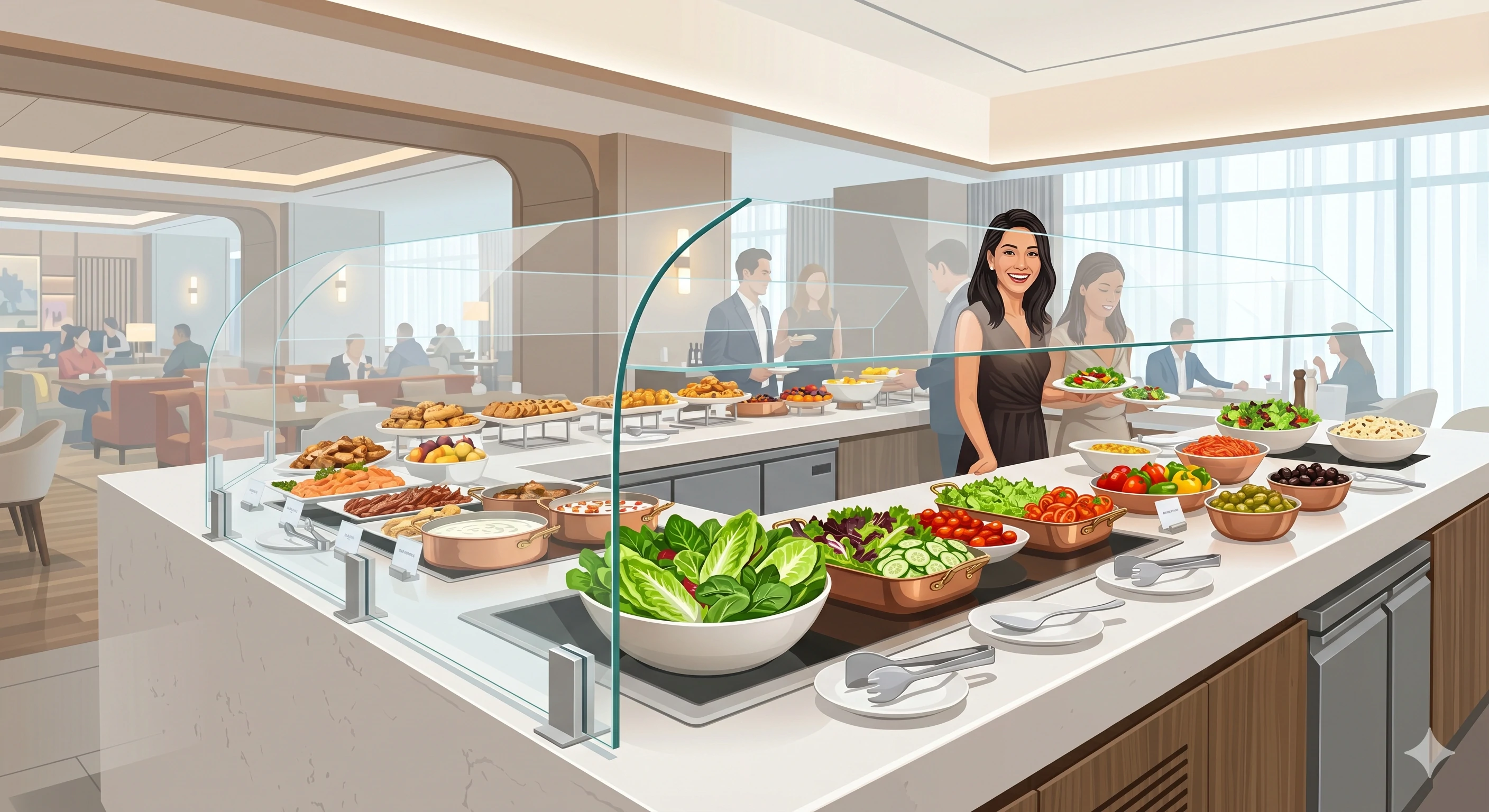
In food service, a sneeze guard isn't optional — it's written into local health codes, NSF standards 1, and FDA Food Code provisions 2. But legal compliance is the bare minimum. The way you present food behind that barrier has a direct line to your average ticket size, customer return rate, and social media shareability.
And that's where most operations get it wrong.
Walk into any outdated buffet or hotel breakfast line and you'll see the same story: thick aluminum frames casting hard shadows on prime rib, bolted posts drilled through a quartz counter 3 that costs more per square foot than the weekly food budget, steam-blackened screws quietly rusting next to a pan of scrambled eggs. Guests don't consciously register these details — but they feel them. The food looks less fresh. The operation looks less serious. The perceived value drops.
Meanwhile, the back-of-house team is at war with the hardware. Fixed frames mean staff can't reach the corners to wipe down steam residue, sauce splatter, or condensation. A single bad health inspection over a neglected seam can shut down service for a weekend.
There's a better way, and it's been engineered specifically for modern commercial counters: frameless glass brackets, edge clamps, and modular posts. This guide walks through how this hardware category solves three problems at once — NSF/FDA compliance, staff efficiency, and five-star presentation — without drilling a single hole in your countertop.
Why Traditional Sneeze Guard Hardware Is Costing You Money
Before we get to solutions, let's name the three silent killers on most buffet lines. If you operate a hotel F&B program, a corporate cafeteria, a casino buffet, or a high-volume salad bar, at least one of these is draining your labor budget right now.
The Cleaning Nightmare
Fixed glass frames — the kind welded into a continuous aluminum channel 4 — have a dirty secret: there's nowhere for the steam to go. Hot food wells push moisture upward all day. That moisture condenses on the underside of the frame, drips down into the seal between the frame and the glass, and sits there. Over months, that trapped moisture does three things:
It corrodes the frame from the inside out, producing flaking metal oxide 5 that can find its way onto food trays. It creates a biofilm seam that's functionally impossible to clean without fully disassembling the unit. And it fails your next health inspection the moment the inspector runs a cotton swab along the frame seam.
Staff know this. They'll tell you the sneeze guard is the single worst thing to clean on the line. Good luck keeping a line cook motivated when half their end-of-shift checklist involves a rag and a prayer.
The Countertop Destruction Problem
Here's the financial anxiety no one talks about in the sales meeting. Traditional sneeze guard posts require core-drilling — usually a 1" to 1.5" bore — straight through whatever material sits on top of your counter.
If that counter is engineered stone 6, marble, or high-grade quartz, you're looking at a real possibility of spidering cracks during the drill. Even if the install goes clean, you now have permanent holes that will haunt you during any future remodel or layout change. Move the salad bar six feet to the left next season? Enjoy patching four core holes in your stone top.
For stainless steel prep counters, drilling compromises the sanitary surface. NSF-certified stainless is designed as a continuous, non-porous plane. Every hole is a new edge, a new crevice, a new failure point for the sanitation protocol the whole counter was built around.
The "Caged Food" Effect
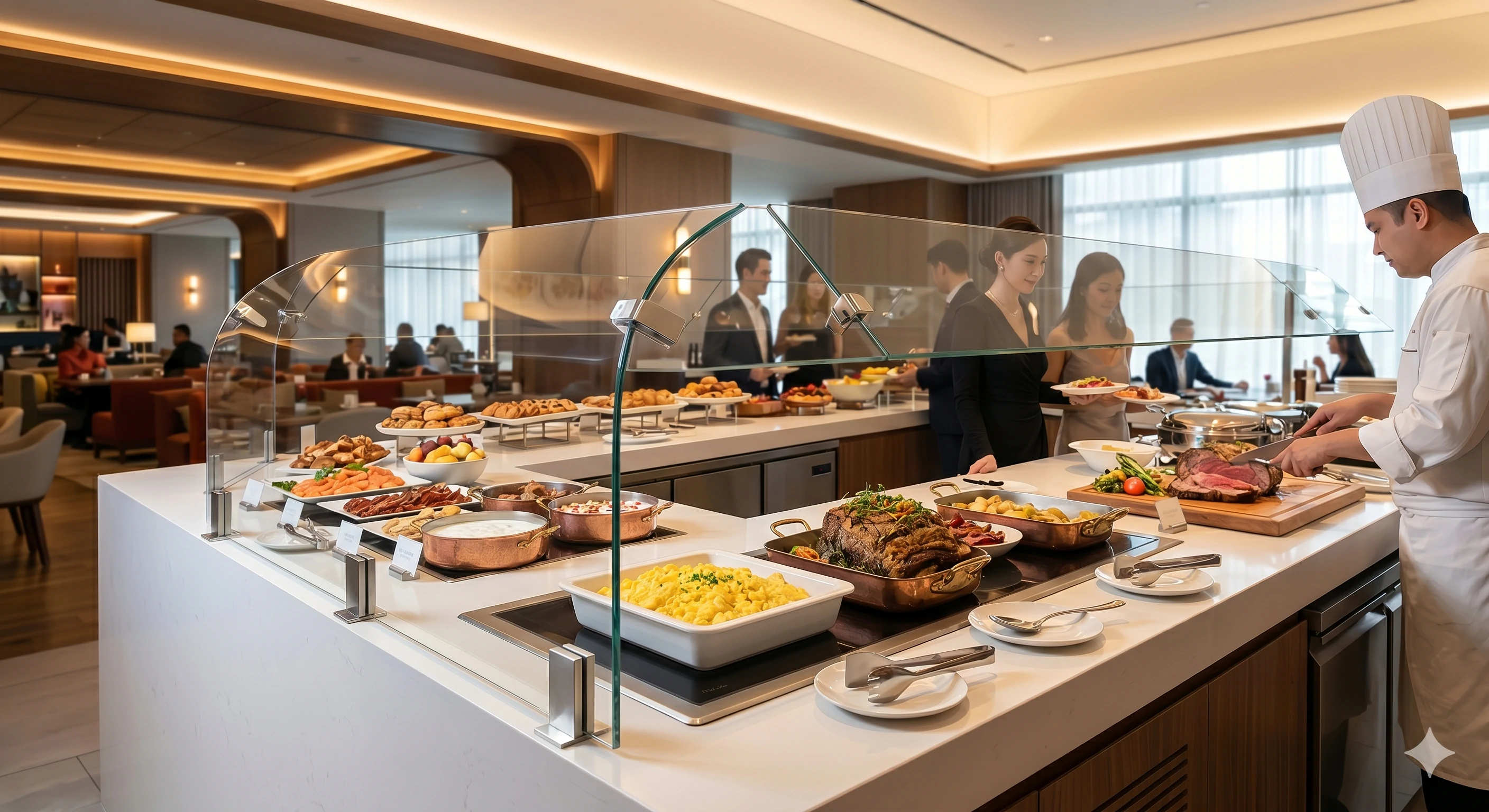
This one is pure psychology, and it shows up in your sales data. Thick metal frames interrupt the sightline between a hungry guest and the food. Frames cast shadows across the pan — shadows that make fresh lettuce look wilted and make a carved roast look gray. Customers pause, subconsciously adjust their expectation of quality downward, and take smaller portions or skip the station entirely.
High-end operations have known this for a decade. That's why every modern Vegas casino, Michelin-tier hotel breakfast 7, and premium cafeteria chain has quietly migrated to frameless glass. The food has to look like it does in the marketing photo. Framed shields make it look like an institutional cafeteria.
How Modular Glass Brackets Actually Solve the Problem
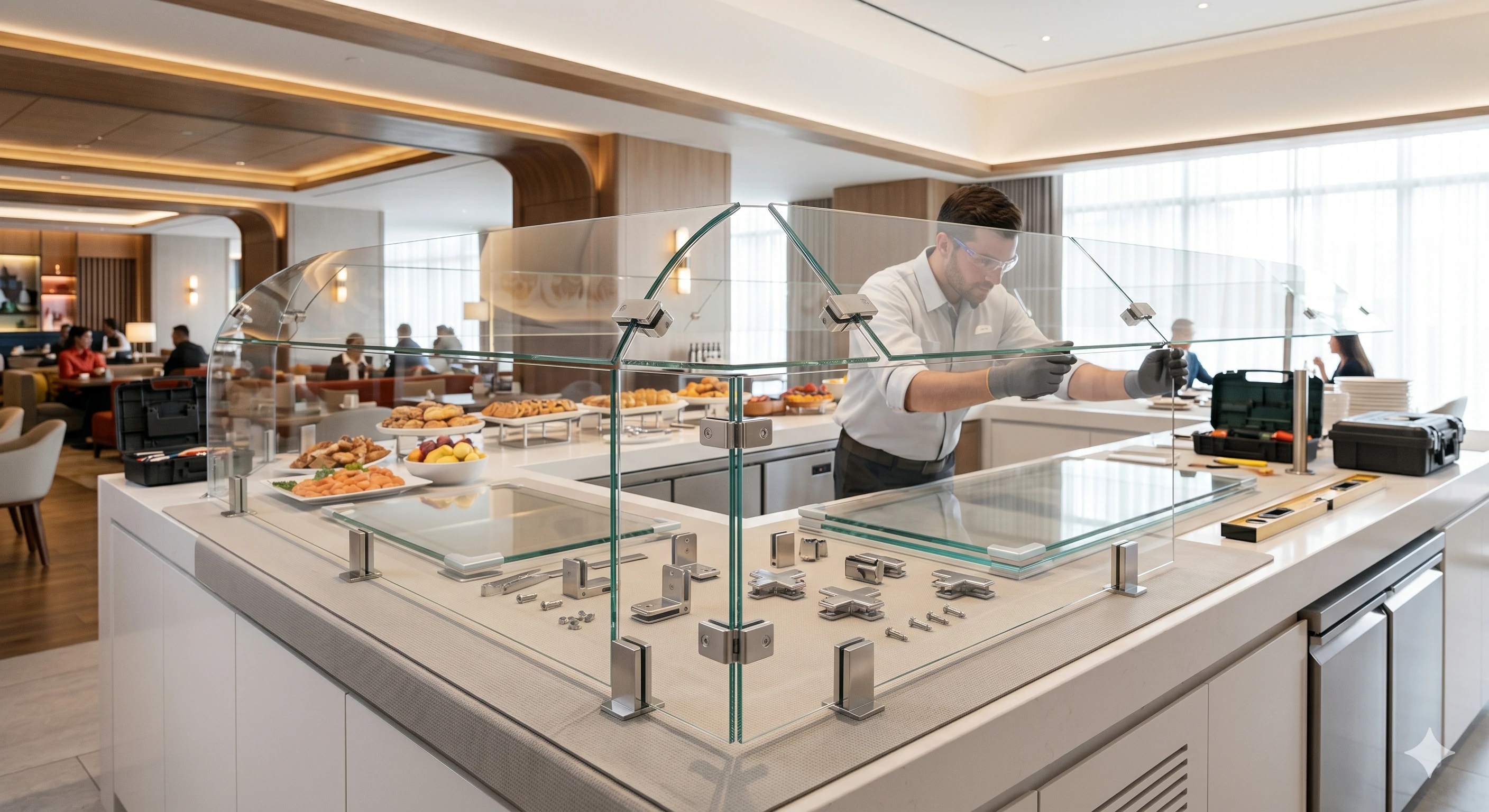
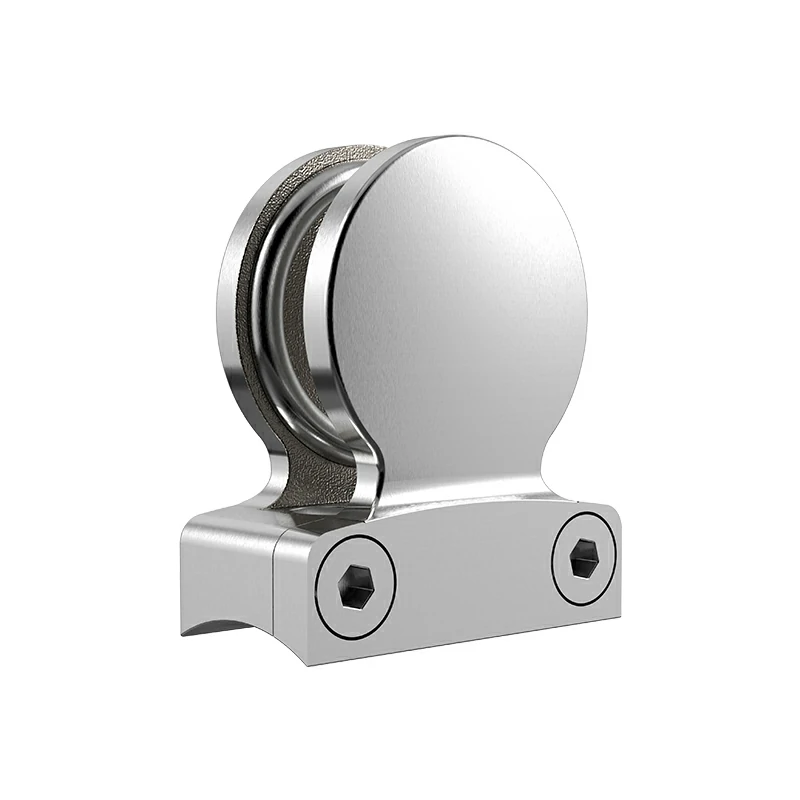
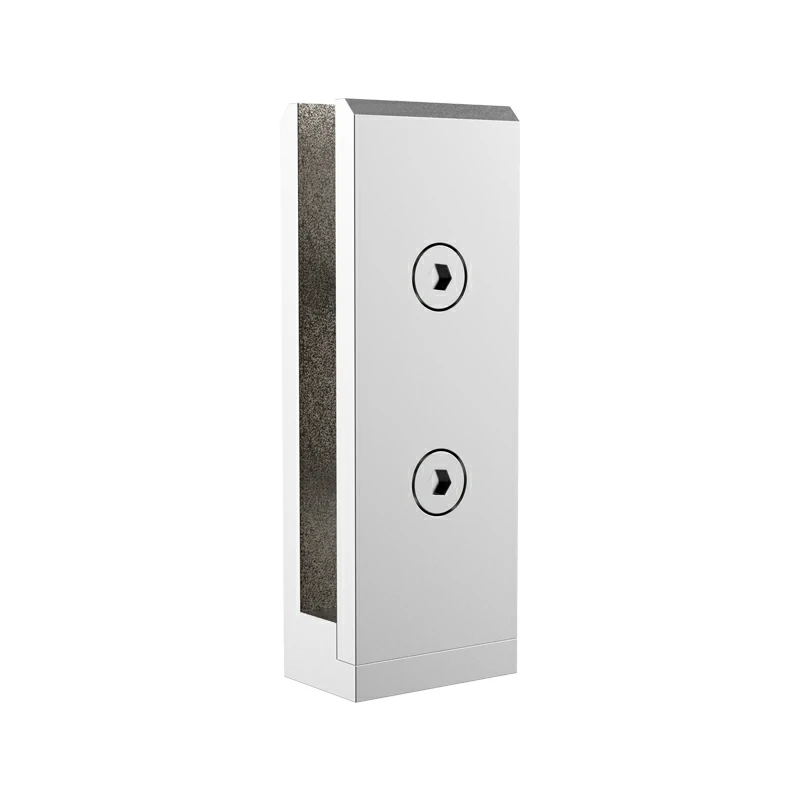
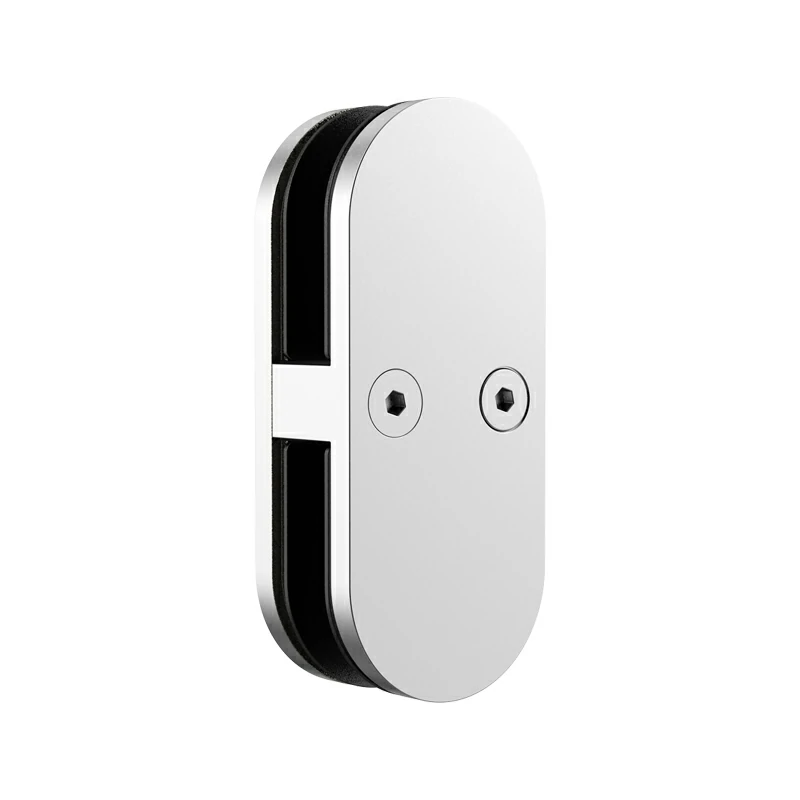
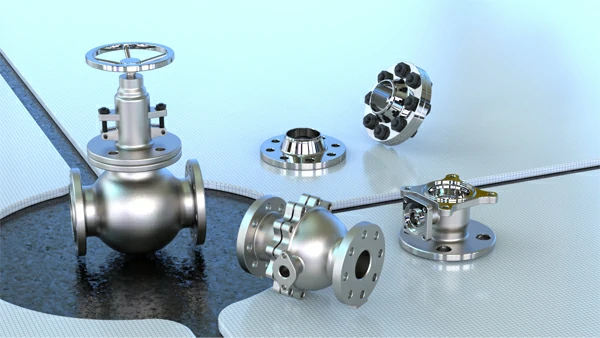
If you've gotten this far, you're probably searching phrases like frameless food shields, drill-free sneeze guards, or adjustable buffet glass. The category you want is modular glass bracket hardware — typically food-grade stainless fittings 8 that hold tempered glass or thick acrylic panels in place using clamp force rather than penetration.
Here's how the three major bracket types work, and what each one solves.
Drill-Free Surface-Mount Base Brackets
The foundation of any drill-free system is the base bracket — the hardware that transfers the weight and wind load of the glass panel into the countertop without puncturing it. Two mechanisms do the heavy lifting:
Industrial VHB (Very High Bond) tape is a closed-cell acrylic foam adhesive rated for structural glazing in commercial building envelopes. It's the same technology used to hold cladding panels onto skyscrapers. Applied correctly to a cleaned and primed stone, stainless, or solid-surface counter, a properly sized VHB pad under a broad stainless base plate will hold a tempered glass panel indefinitely under normal commercial loads — including the lateral force of a customer leaning into it.
Mechanical clamp bases work where adhesive isn't appropriate. These brackets grip the edge of the counter itself, much like a C-clamp, and distribute load through rubber or silicone gaskets that protect the finish. For drop-in food wells or mobile banquet stations, this is often the preferred route because the bracket can be removed and repositioned without trace.
Either way, the result is the same: a secure, rigid, height-adjustable base for your glass panel with zero holes in the counter.
Fold-Down and Pivoting Brackets
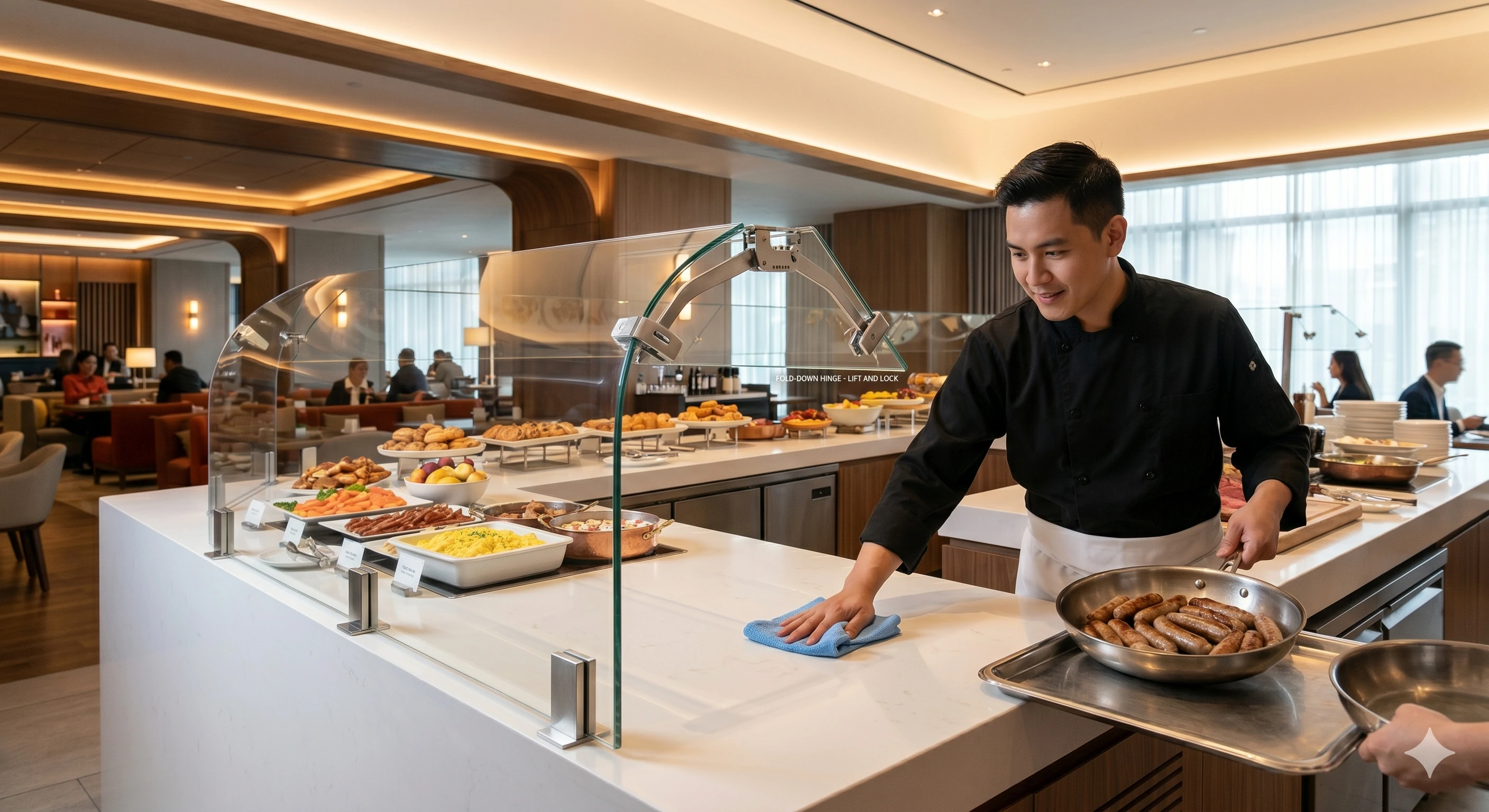
This is where the cleaning nightmare ends. Fold-down brackets use a precision stainless hinge at the base of the glass panel. At a single motion — usually a push upward and outward — the front glass panel pivots to horizontal or folds back entirely, exposing 100% of the counter surface underneath.
The operational impact is dramatic. Breakdown and sanitation at the end of service, which used to involve awkward reaching and compromise cleaning, now takes a fraction of the time. Tray swaps during service (the moment when the hash browns run out at 8:47 AM and the manager is sweating) become a one-person, one-motion job. Deep-cleaning the glass itself — both sides — can be done in place without removing the panel.
Look for hinges rated for at least 10,000 actuation cycles with a locking detent so the glass stays up while staff work underneath. Cheap hinges will fatigue within a season of real-world use.
Modular Connectors for Custom Layouts
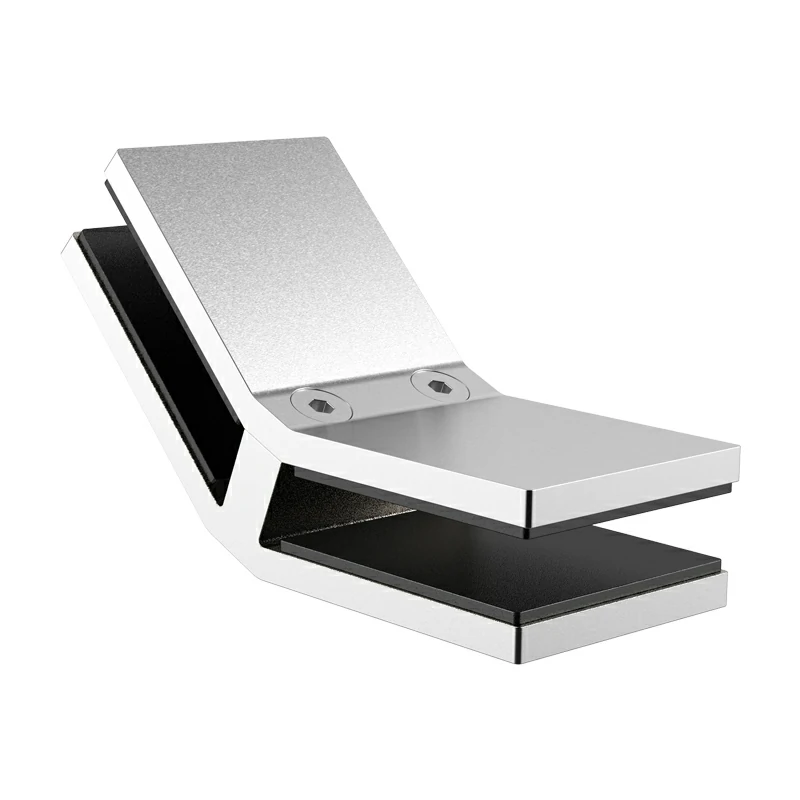
Here's the move that separates a professional contractor install from an amateur one. Instead of specifying an expensive custom-bent glass panel for your L-shaped or U-shaped counter — which takes six to ten weeks of lead time and ships at freight rates that make you audibly groan — you build the shield out of flat standard-sized glass panels connected with modular corner brackets.
The bracket inventory is straightforward: 90-degree corner clips for square turns, 135-degree clips for angled prep stations, and straight D-clamps or T-connectors for continuous runs and mid-panel supports. With a half-dozen SKUs, a contractor can build a sneeze guard to fit almost any counter geometry on the floor plan.
The practical advantage is enormous. Standard glass panels ship in a week from domestic stock. If a panel chips during unloading, you replace that one panel — not the entire custom assembly. If the restaurant ever reconfigures the dining room, the shield reconfigures with it.
Why Premium Commercial Hardware Pays for Itself
At this point in the buying process, a reasonable operator asks the reasonable question: can I just buy the $89 acrylic sneeze stand from an online marketplace instead? You can. It will not end well. Here's the hard comparison that matters for long-term cost, compliance, and brand.
304 Stainless Steel vs. Plated Alloys: The Material Question
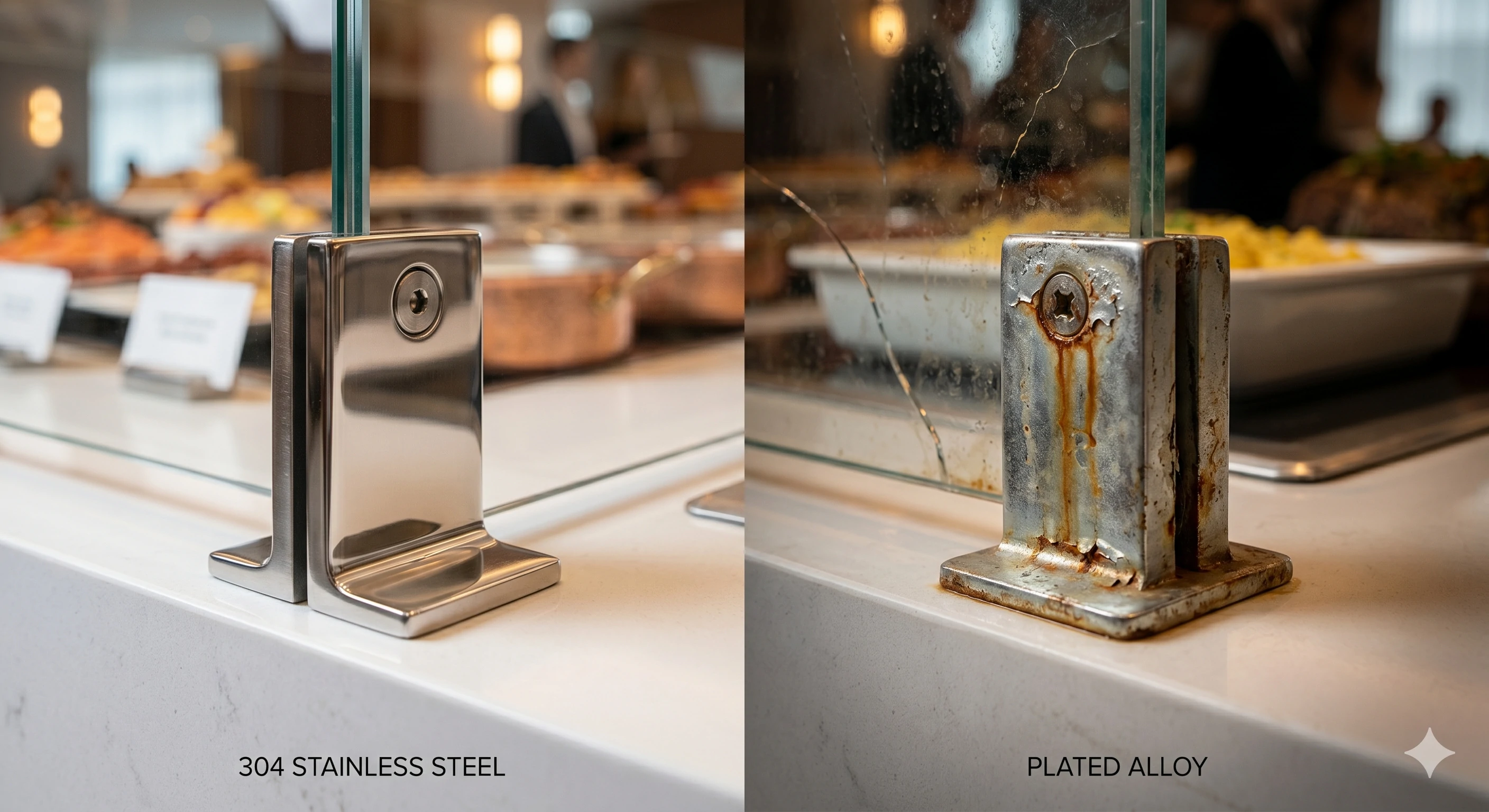
Commercial food environments are uniquely hostile to metal. In a single shift, bracket hardware at a buffet line encounters boiling steam (driving moisture into every seam), acidic food residues like tomato sauce, vinegar, and citrus juices (which will eat through non-food-grade metal), and quaternary ammonia sanitizers 9 plus chlorine-based cleaners applied multiple times per day.
This is why the floor-is-lava rule for buffet bracket hardware is 304 stainless steel minimum, 316 for coastal or high-salt environments. The chromium content in 304 (18% minimum) forms a self-healing passive oxide layer that resists the entire chemical cocktail above. Cheap alternatives — zinc-plated steel, chrome-plated pot metal, anodized aluminum — will look similar on day one. By month six, the plating will have blistered at the seams, the underlying metal will be weeping rust down your glass, and the bracket will need to be replaced.
The economics are not subtle. A proper 304 stainless bracket has a 10-to-15-year service life in a commercial buffet environment. A plated alloy bracket typically fails inside 18 months. The cheap bracket isn't cheap — it's a subscription.
Modular Brackets vs. Custom Welded Frames: The Project-Cost Question
Custom-welded stainless frames have their place, but for most buffet and counter applications they're the wrong tool. Custom fabrication typically runs four to eight weeks of lead time, ships at LTL freight rates (often $400–$800 per unit), and arrives as a single non-modifiable assembly. If the measurement was off by half an inch, you're sending it back.
A modular bracket system sits at the opposite end of the trade-off curve. Hardware ships overnight from domestic distributors. A skilled contractor can install a 12-foot run in an afternoon. Measurements that are off get corrected on-site with a second cut of flat glass — usually available same-day from a local glass shop. And three years from now, when the concept evolves into a live-action station, the same hardware reconfigures to the new layout.
For new-build and remodel projects on a timeline, the difference isn't a slight preference. It's often the difference between opening on schedule and missing your launch.
The Compliance Guarantee
The final argument is about risk. Health inspectors aren't grading the aesthetic of your sneeze guard — they're measuring it. The FDA Food Code and NSF/ANSI Standard 2 10 specify that food protection shields must intercept a direct line from the average customer's mouth to the exposed food, with specific geometry depending on the height of the counter and the distance of the customer approach.
Rigid, properly engineered glass brackets ensure the panel stays in specification — correct height, correct angle, no sag, no drift. Thin acrylic stands flex over time and can drop out of compliant geometry without anyone noticing until the inspector pulls out a tape measure. A pass on day one is easy. A pass every quarter for the next decade is what premium bracket hardware actually buys you.
When inspectors see stainless bracket hardware holding tempered glass at a measured angle, the conversation is over in thirty seconds. That's worth something.
Conclusion: The Shield Should Protect the Food, Not Hide It
The job of a sneeze guard is to be present when it matters for hygiene and invisible everywhere else. Premium modular glass brackets are how modern food service operations get both — FDA-compliant safety, drill-free installation that protects expensive counters, fold-down access that transforms staff workflow, and crystalline sightlines that let the food do the selling.
If you're specifying hardware for a new build, a remodel, or a routine replacement of failing equipment, the math is on the side of doing it right once: food-grade 304 stainless brackets, modular connector hardware for your specific counter geometry, and fold-down hinges wherever staff need to reach under the glass.
Footnotes
1. Explore official requirements for certified food service equipment. ↩︎
2. Official guidelines on retail and food service safety standards. ↩︎
3. Learn about the composition and properties of engineered quartz surfaces. ↩︎
4. Understand the industrial process used to create structural aluminum profiles. ↩︎
5. Discover the chemical mechanisms behind metal degradation and rust. ↩︎
6. Details on the manufacturing and durability of composite stone materials. ↩︎
7. Discover global standards for high-end dining and hospitality excellence. ↩︎
8. Learn the specifications required for metals contacting consumable products. ↩︎
9. Insight into the chemistry of standard commercial antimicrobial agents. ↩︎
10. Review standard criteria for commercial food equipment design and fabrication. ↩︎