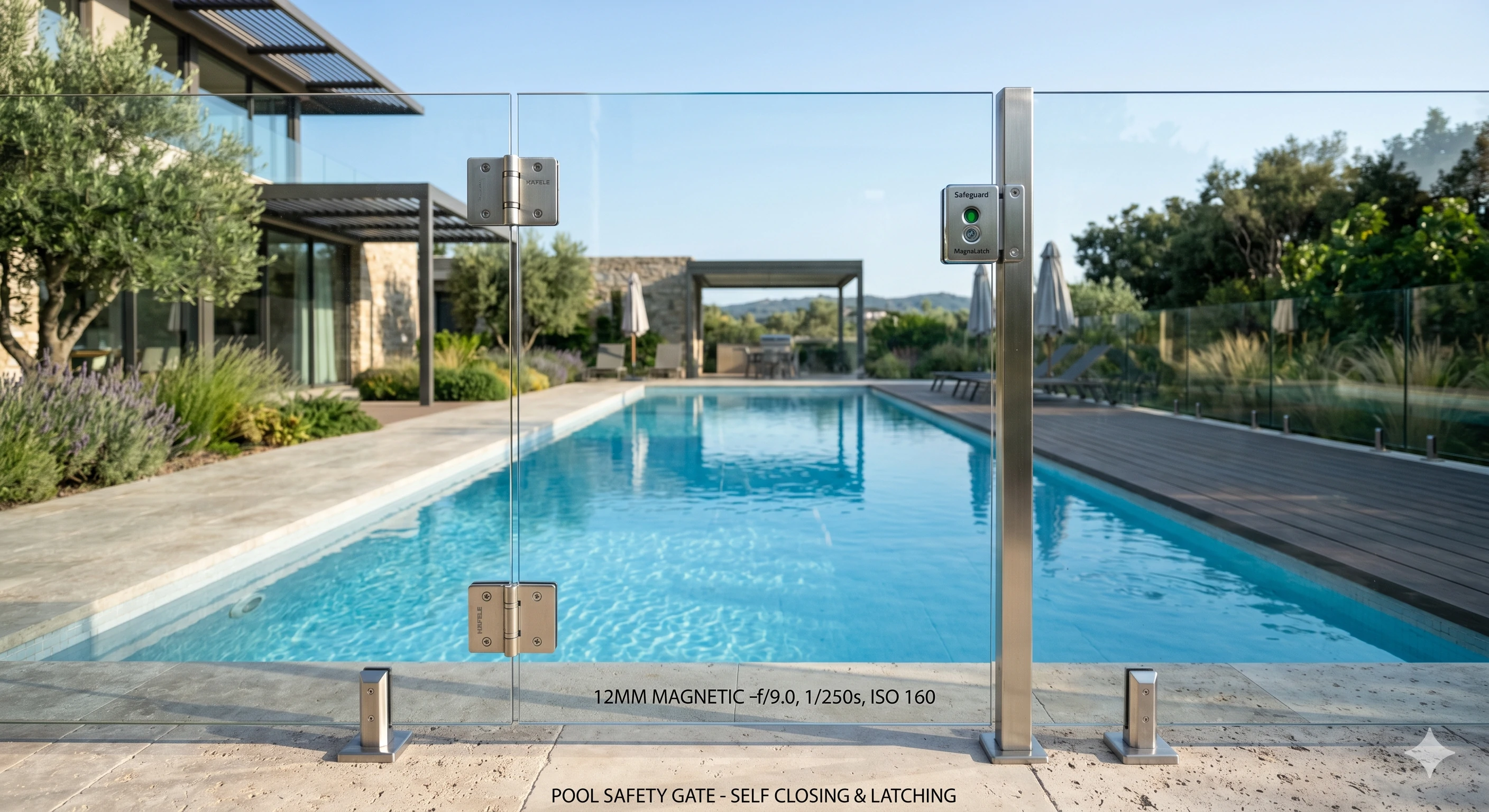
A swimming pool is the crown jewel of any backyard — a private resort for weekend barbecues, summer afternoons, and family memories. But it is also, without exception, the single biggest liability on the property. Unlike a sharp tool you can lock away or a hot stove you can turn off, a pool is an open hazard 24 hours a day, 365 days a year. And the only thing standing between that hazard and a curious toddler, a distracted guest, or an unsupervised moment is a single gate.
Here is the uncomfortable truth: you cannot rely on human memory to keep that gate closed. Kids are fast. Adults are distracted. Hands are full of towels, snacks, and pool toys. A gate left ajar for even a few seconds can turn a backyard paradise into the scene of a tragedy — and failing to meet strict local can trigger massive fines, stop-work orders, and indefinitely delayed construction sign-offs.
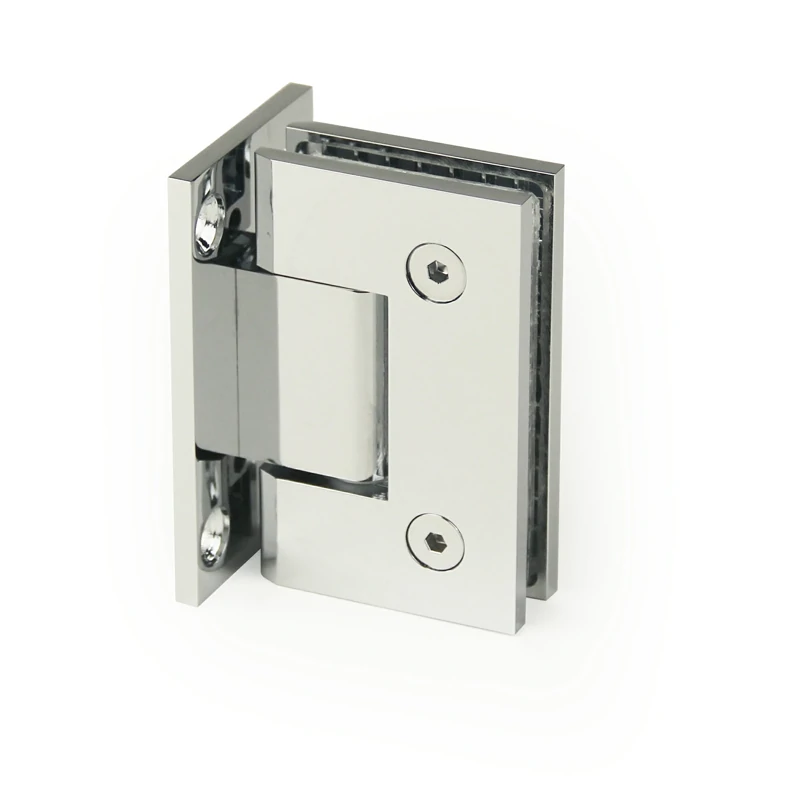
This is where the heavy-duty, earns its place. It is not just a piece of hardware. It is an active, fail-proof security guard that removes human error from the equation entirely, ensuring the gate closes and latches securely every single time — whether anyone is watching or not.
This guide walks you through exactly why spring hinges are non-negotiable for pool safety, how to choose the right ones for your environment, and how to compare premium options so you install once and never worry again.
Why Standard Gate Hardware Fails at the Pool Deck
Before we talk solutions, let's be honest about the problem. Most pool gate failures are not dramatic — they are slow, silent, and compound over time. If you are dealing with a sagging gate, a failed inspection, or the creeping anxiety that your gate might not actually be closed right now, you are not alone. These are the three most common ways conventional hardware lets property owners down.
1. The Human Error Factor
The majority of are not caused by broken gates. They are caused by open ones.
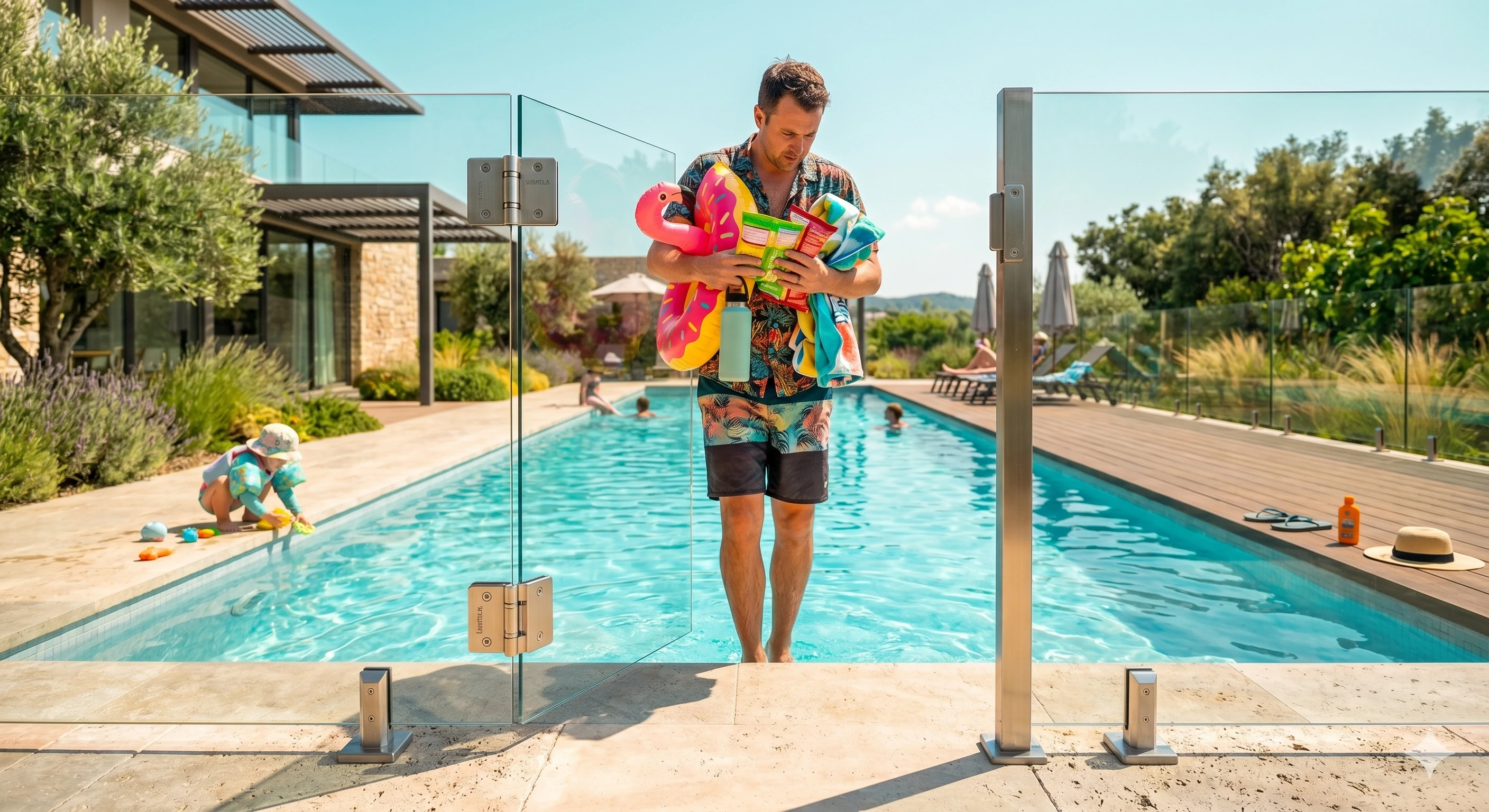
Think about the real-world choreography of a pool day. Someone is carrying a tray of drinks in both hands. A parent is chasing a toddler. A teenager is hauling pool floats. A guest is ducking out for their phone. Every one of those trips through the gate is an opportunity for someone to nudge it behind them and assume it latched — without ever looking back.
A gate without an active, automatic closing mechanism is fundamentally unsafe because it depends on the one variable you cannot control: human attention. You need hardware that closes the gate for them, not hardware that hopes they remember.
2. The Sagging Gate Dilemma
Metal gates are heavy. Glass pool fence panels are heavier still. Over months and years of being swung open and slammed shut, cheap hinges simply cannot hold that weight in perfect alignment.
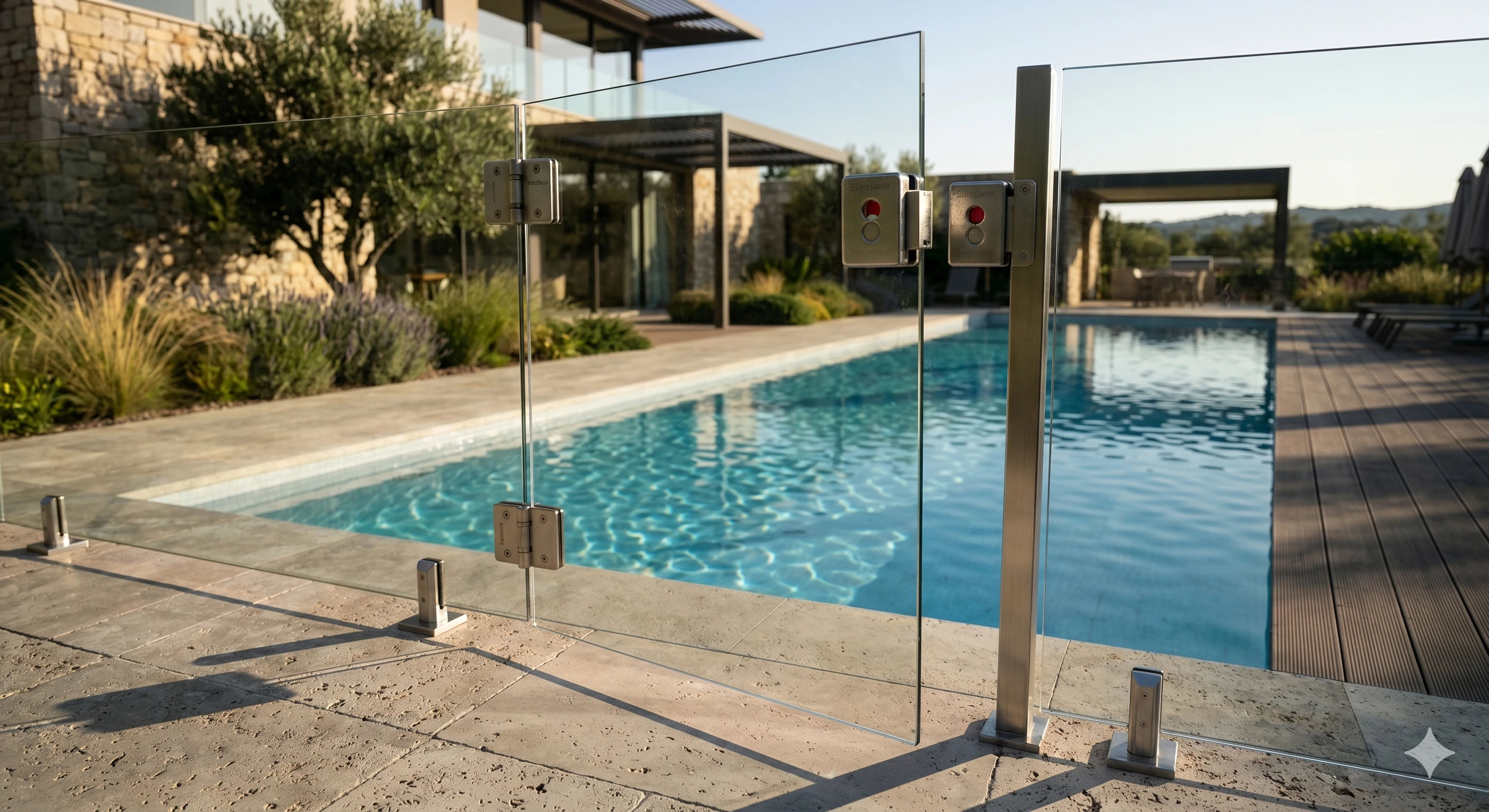
The failure mode is subtle and dangerous: the hinge bearings wear, the gate drops a fraction of an inch on the latch side, and suddenly the that once clicked shut now drags just beneath the strike. The gate looks closed from ten feet away. It even sounds closed when it bumps the post. But it is not latched — and a three-year-old can push it right open.
A properly engineered spring hinge with a load-rated bearing eliminates this mechanical drift entirely.
3. The Corrosion Nightmare
Now add the pool deck environment. onto the gate every time someone gets out. Saltwater pool systems release into the air. Coastal properties face salt spray from the ocean. Liquid chemistry is eating your hardware the moment it is installed.
Standard zinc-plated steel or low-grade stainless will pit within a single season. Within two or three years, the springs inside the hinge seize up, the tension disappears, and the "self-closing" gate stops closing altogether. By the time you notice, the gate has been coasting back to an unlatched rest for weeks.
This is not a maintenance problem you can solve with grease. It is a materials problem that has to be solved at the specification stage.
How Adjustable Spring Hinges Solve the Problem
Once you know you need self-closing hardware, the next question is which self-closing hardware. Not all spring hinges are created equal, and the engineering differences between economy and commercial-grade models determine whether your gate will pass inspection — and keep passing it for years.
The Adjustable Tension Mechanism
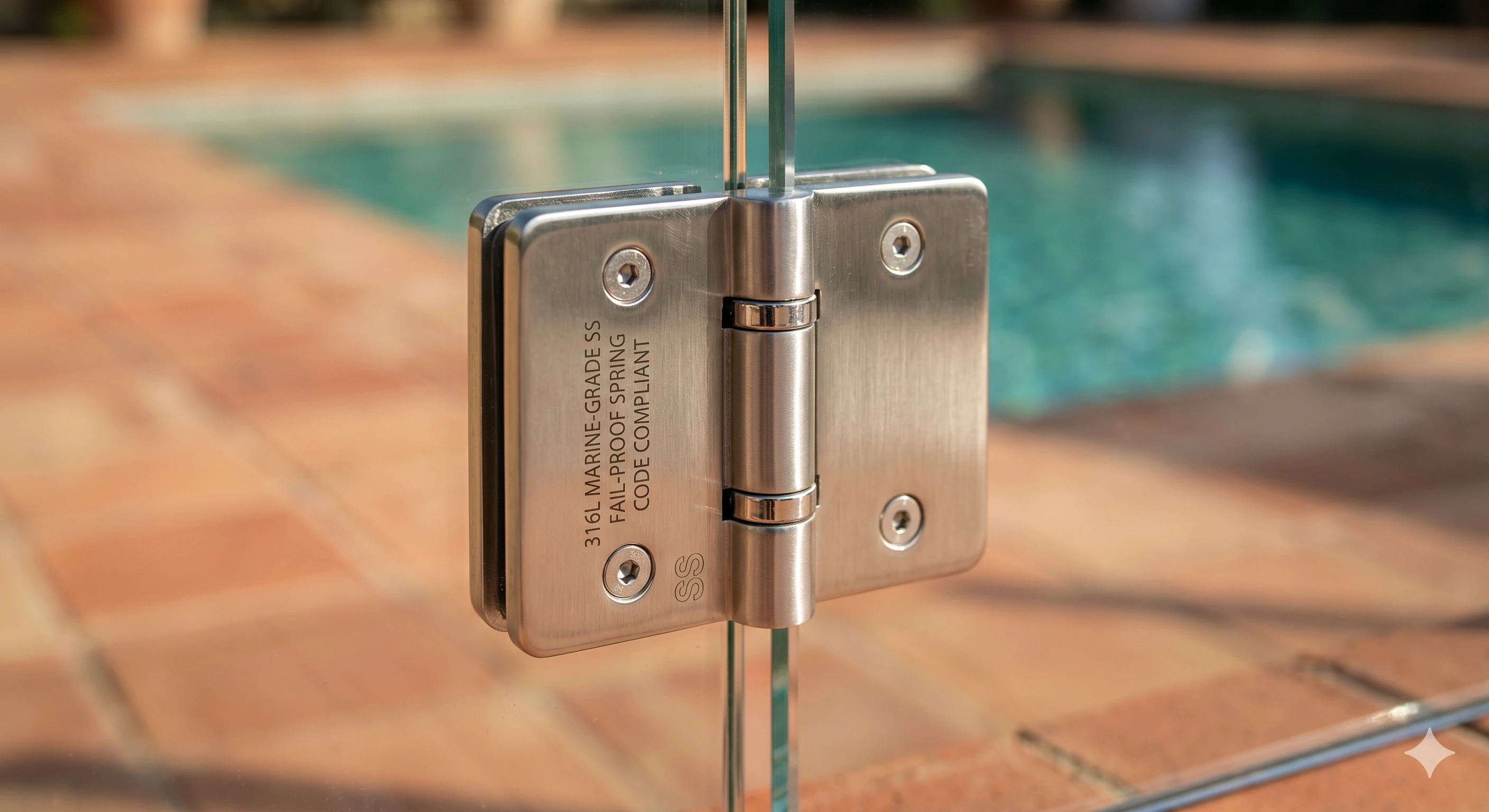
At the core of a quality spring hinge is an with user-adjustable tension. Using a simple hex key or tension pin, the installer can dial in the exact amount of closing force required for that specific gate.
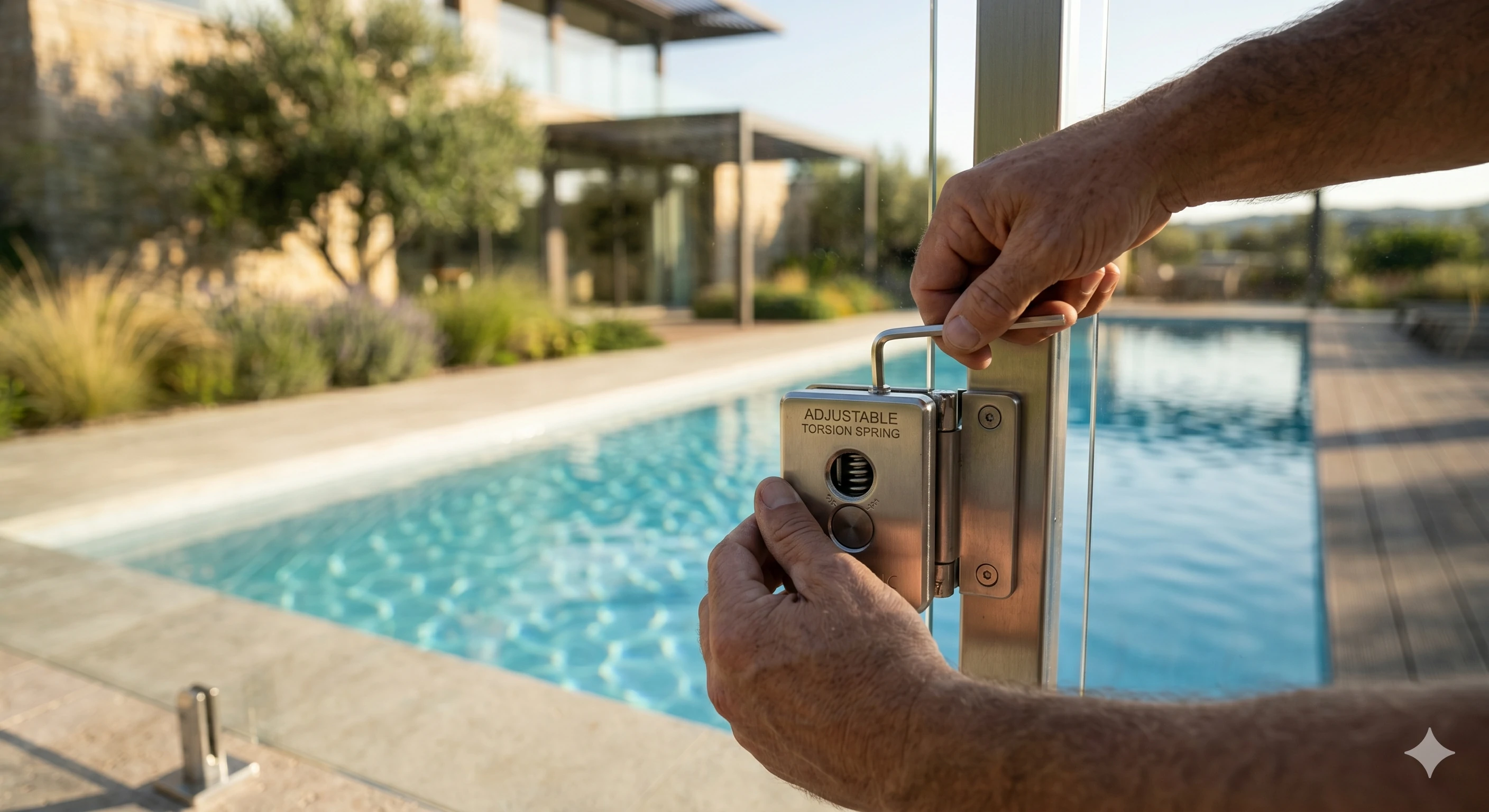
Why does adjustability matter so much? Because every gate is different. A lightweight aluminum gate needs less tension than a wrought-iron one. A gate installed on a windy hillside needs more force than one sheltered by a wall. A gate with a stiff magnetic latch needs enough authority to drive the latch home from any open position.
With adjustable tension, you can guarantee that whether the gate is opened 10 degrees for a quick pass-through or swung fully to 90 degrees, it returns with precisely the right force to engage the safety latch — no slamming, no dragging, no coasting short.
Defeating the Elements: Material Matters
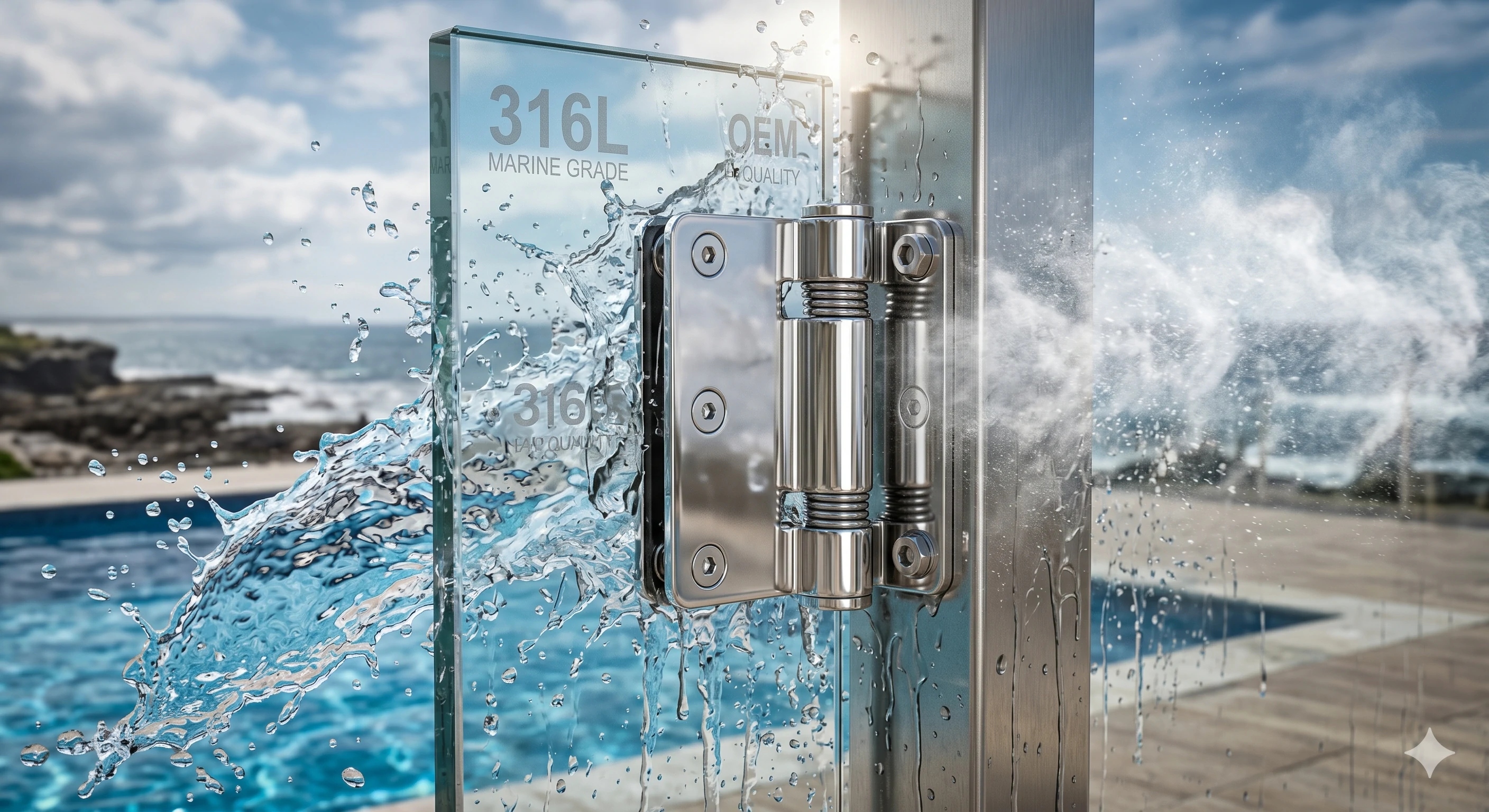
The single most important spec on a pool gate hinge is its base material. For any installation within 20 feet of , there are really only two serious options:
316L Marine-Grade Stainless Steel is the gold standard. Unlike common 304 stainless, the 316L alloy contains molybdenum, which gives it exceptional resistance to chloride pitting. It is the same grade used in boat fittings, oil rig hardware, and coastal architectural applications. It will not rust, seize, or stain the surrounding gate posts.
High-strength engineered polymers are the other legitimate option, particularly for residential glass pool fencing. Premium polymer hinges use stainless internals housed in a UV-stable, chemical-resistant polymer body. They are completely impervious to pool chemistry, silent in operation, and often easier to install on frameless glass panels.
Anything else — zinc-plated steel, brass, aluminum alloys, budget "stainless" of unspecified grade — is a false economy. It will fail, usually in the second or third year, and you will be replacing it under worse conditions than the original install.
Passing Strict Building Codes
Self-closing, self-latching gates are not a suggestion. In most jurisdictions, they are the law.
Depending on your region, pool barrier requirements fall under codes such as the , BOCA standards in parts of the United States, or AS 1926.1 in Australia. The specific numbers vary, but the core requirements are consistent across virtually every developed jurisdiction:
The gate must swing outward, away from the pool. The gate must be self-closing from any open position. The gate must be self-latching, with the release mechanism located at a specified minimum height above the ground. The gate must not be able to be held open by gravity or wind.
Adjustable spring hinges paired with a compliant magnetic latch are the direct engineering solution to every one of these requirements. There is no workaround, no retrofit, and no inspector who will accept a standard butt hinge on a pool gate.
Choosing the Right Spring Hinge: A Feature Comparison
If you have reached this section, you already know you need spring hinges. The remaining question is which tier of spring hinge makes sense for your project. Here is how the options stack up.
Economy Spring Hinges vs. Hydraulic Soft-Close
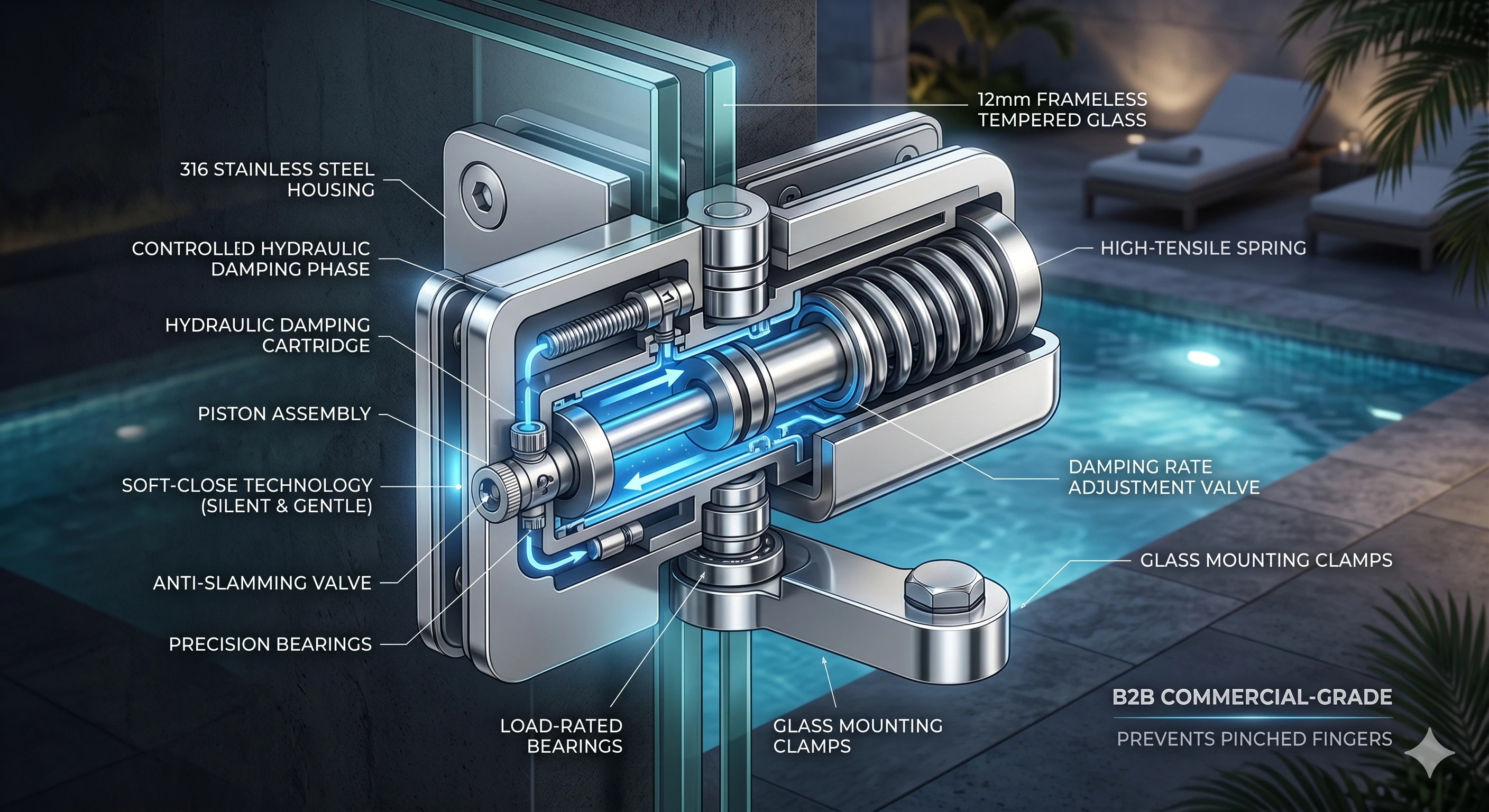
Standard spring hinges do the core job — they close the gate and engage the latch. But they close it with whatever tension you dialed in, which means at higher tension settings, the gate can slam hard enough to wake the neighbors, pinch small fingers, or rattle a glass panel loose from its clamps.
Hydraulic soft-close spring hinges solve this with a built into the hinge body. The spring drives the gate closed with full authority, but in the final 10 to 15 degrees of travel, the hydraulic damper takes over and eases the gate into the latch silently. The result is a gate that closes with the certainty of a commercial spring hinge and the gentleness of a luxury car door — no slam, no pinch risk, no startled guests.
For any high-traffic residential or hospitality pool, the soft-close upgrade is worth every dollar of the price premium.
Heavy-Duty vs. Standard Load Capacity
Hinge load ratings matter more than most spec sheets make obvious. A pair of standard spring hinges rated for 66 pounds is perfectly adequate for a lightweight aluminum picket gate. Put that same hinge on a wide, dense wrought-iron gate or a double-panel glass gate, and you are back to the sagging problem within a year.
For gates over roughly 48 inches wide, over 110 pounds total weight, or subject to heavy commercial use (hotels, HOA pools, water parks), specify heavy-duty or commercial-grade spring hinges with load ratings well above the actual gate weight. Welded mounting options and oversized bearing surfaces eliminate the micro-wear that causes drift over time.
It is cheaper to over-spec the hinge than to replace the gate.
The True Cost of Cheap Hardware
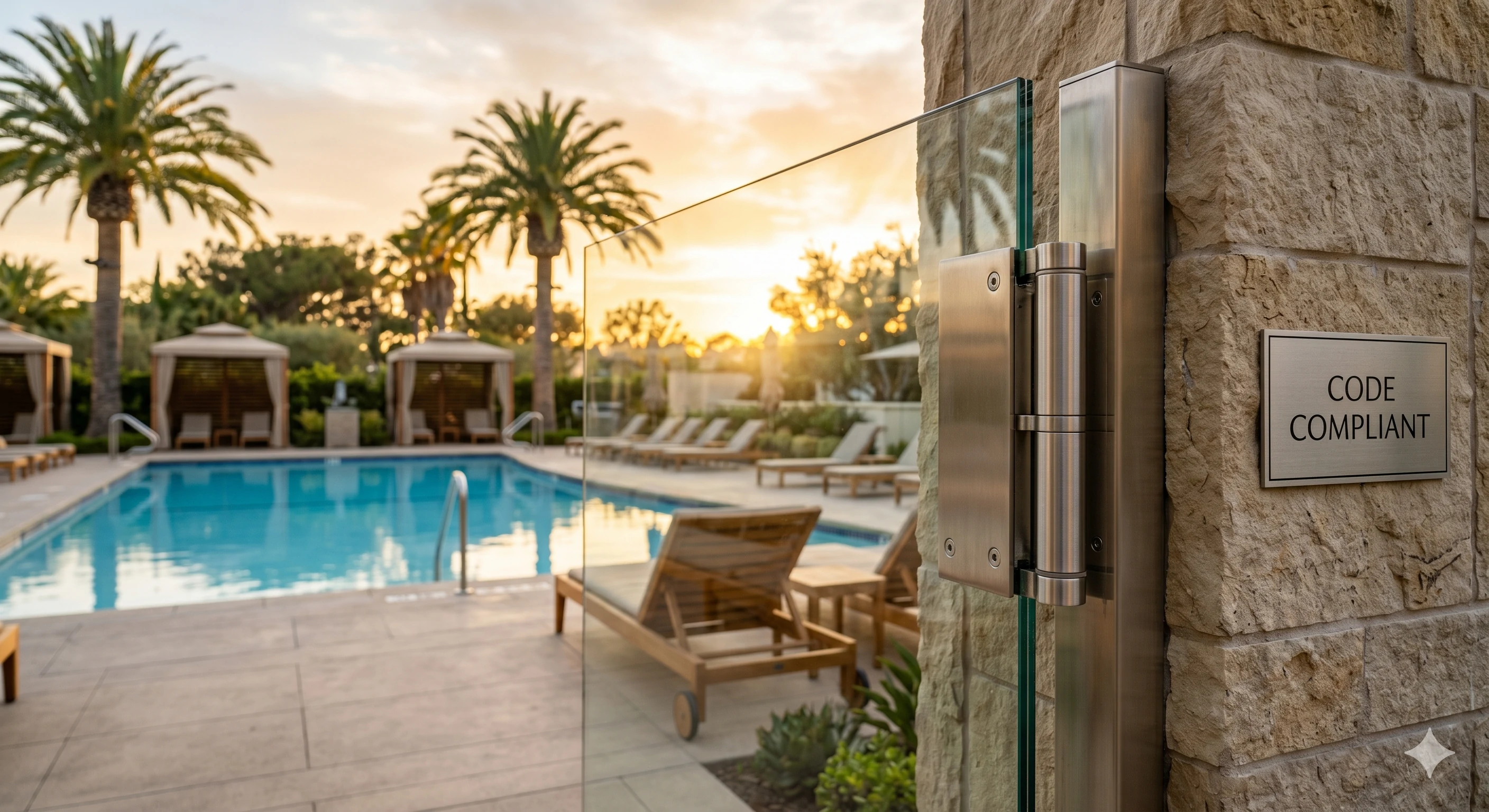
It is tempting to save $80 per gate by buying the discount hinges from a big-box store. Contractors do it. Homeowners do it. And then they pay for it.
A failed inspection can delay project sign-off by weeks, tying up capital and escalating labor costs. A rusted hinge discovered two years in means a full hardware replacement, often with the gate already installed — which is a much messier job than specifying it correctly the first time. A sagging gate that appears latched but is not is the kind of liability that follows a property owner into court.
The honest math: premium marine-grade spring hinges cost a fraction of a percent of the total pool installation. They are the cheapest insurance policy you will ever buy against the single largest liability on the property.
The Bottom Line
A pool gate is only as safe as the hinges that swing it. Every other component of a pool barrier — the fence panels, the latch, the post mounts — depends on the gate returning to a closed, latched position every single time it is opened. Human memory cannot guarantee that. Adjustable, corrosion-resistant spring hinges can.

For residential homeowners, this is peace of mind. For contractors and architects, this is code compliance and freedom from costly callbacks. For facility managers running commercial aquatic properties, this is operational risk management at the hardware level.

Specify it right once, and the gate takes care of itself for a decade or more.
Secure Your Pool Perimeter Today
Browse our complete catalog of commercial-grade, 316L marine-stainless spring hinges — including adjustable tension, hydraulic soft-close, and heavy-duty load-rated models engineered for demanding pool environments.
For architects, builders, and facility managers, our team offers bulk B2B pricing, compliance consultation, and custom specifications for your next project. Contact our architectural hardware team today to make sure your pool gate closes safely every single time — without exception.
View Spring Hinges
View Pool Glass Door Latches
Footnotes
1. Review official guidelines to ensure residential pool enclosures meet national safety standards.
2. Learn the mechanical principles behind hinges designed to automatically close doors and gates.
3. Statistical research on drowning incidents emphasizes the danger of unsecured pool access.
4. Understand how gravity and magnetic latches secure access points effectively.
5. Information on how pool chemicals interact with surrounding environments and materials.
6. Learn how chloride exposure accelerates localized pitting corrosion on metals.
7. Technical overview of torsion springs and how they store mechanical energy.
8. CDC guidance on maintaining and managing chemistry in residential salt water pools.
9. Access the official international building codes governing pool and spa safety barriers.