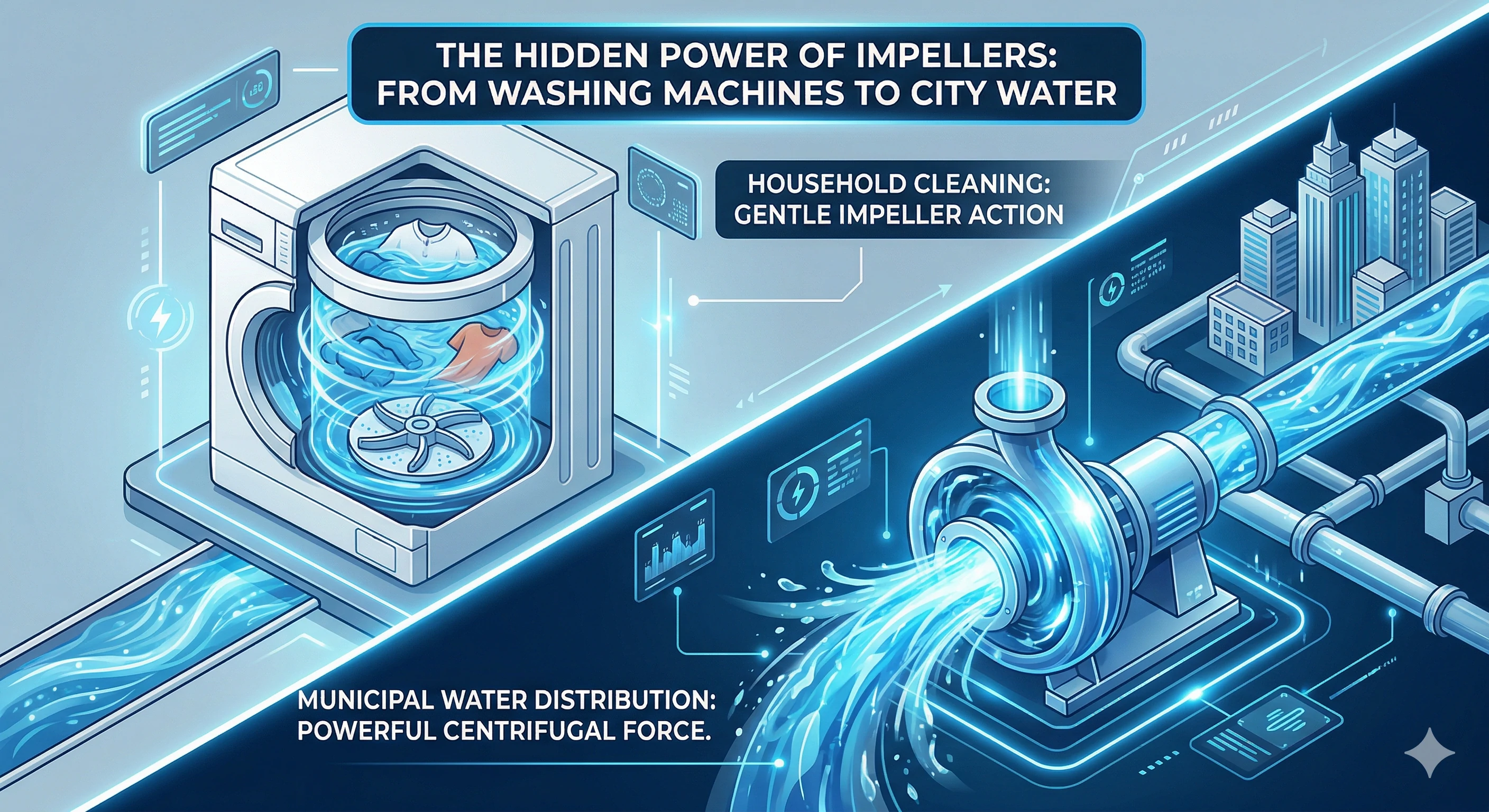
If you have ever used a centrifugal pump, turned on a washing machine, or ridden in a jet boat, you have relied on an impeller. This rotating component is at the heart of countless machines that move fluids — from to life-saving . Yet many engineers, maintenance professionals, and curious learners struggle to find a single resource that covers everything they need to know.
This guide changes that. Below, you will find a thorough breakdown of what an impeller is, how it works, the different types available, the materials they are made from, and the practical considerations that determine which impeller is right for a given application. We also answer every common question — including how impellers compare to propellers and agitators.
Table of Contents
What Is an Impeller?
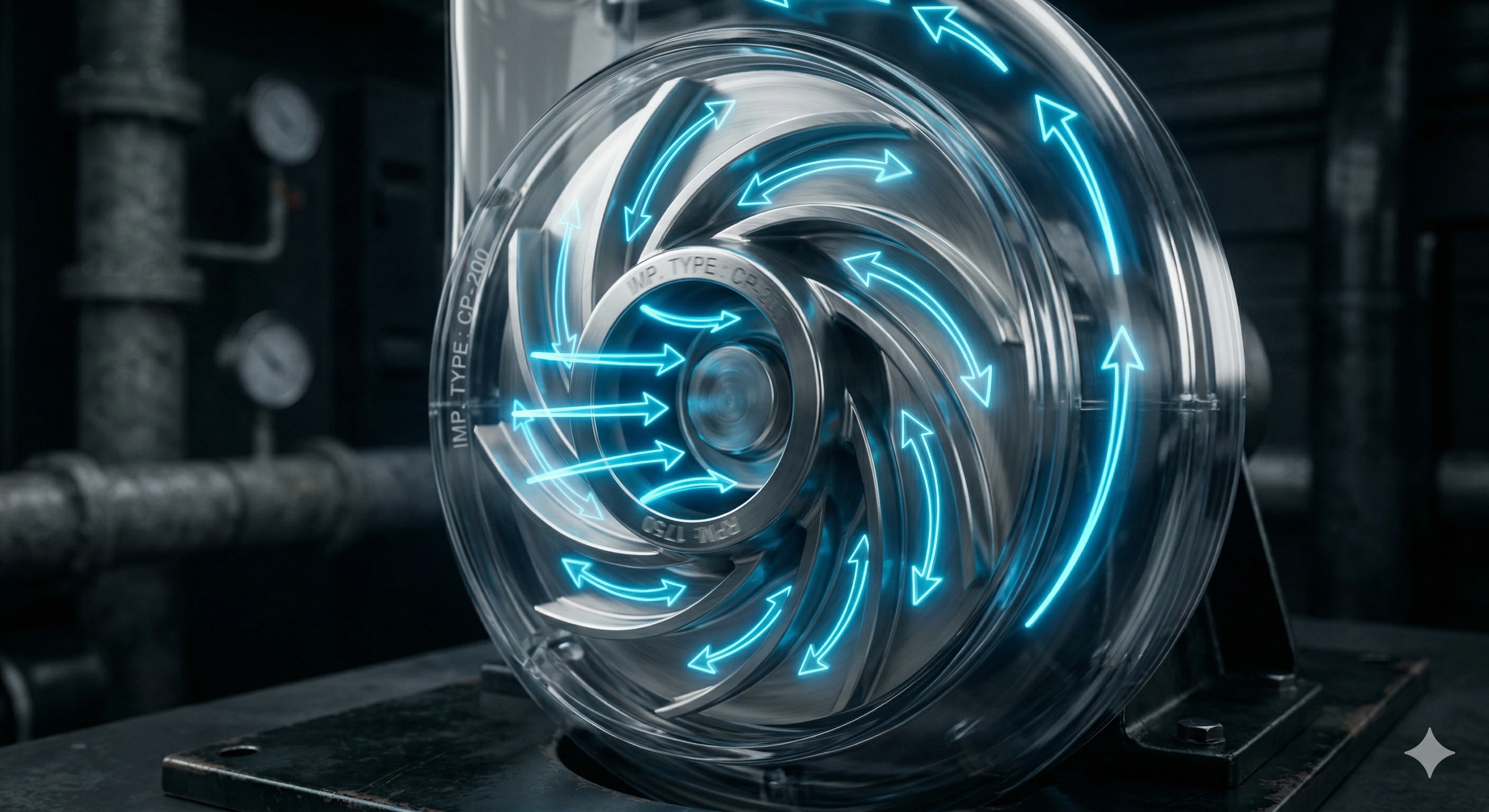
An impeller is a rotating component — typically a short cylinder fitted with curved vanes — that . When it spins, it accelerates the surrounding liquid (or gas) outward from its center of rotation, increasing both the velocity and pressure of the fluid.
You will find impellers inside centrifugal pumps, compressors, jet engines, mixing tanks, and even household appliances like dishwashers and washing machines. The component usually features an open inlet, often called the "eye," where fluid enters. Vanes on the impeller then push that fluid radially outward, and the pump casing confines and redirects the flow to generate usable pressure.
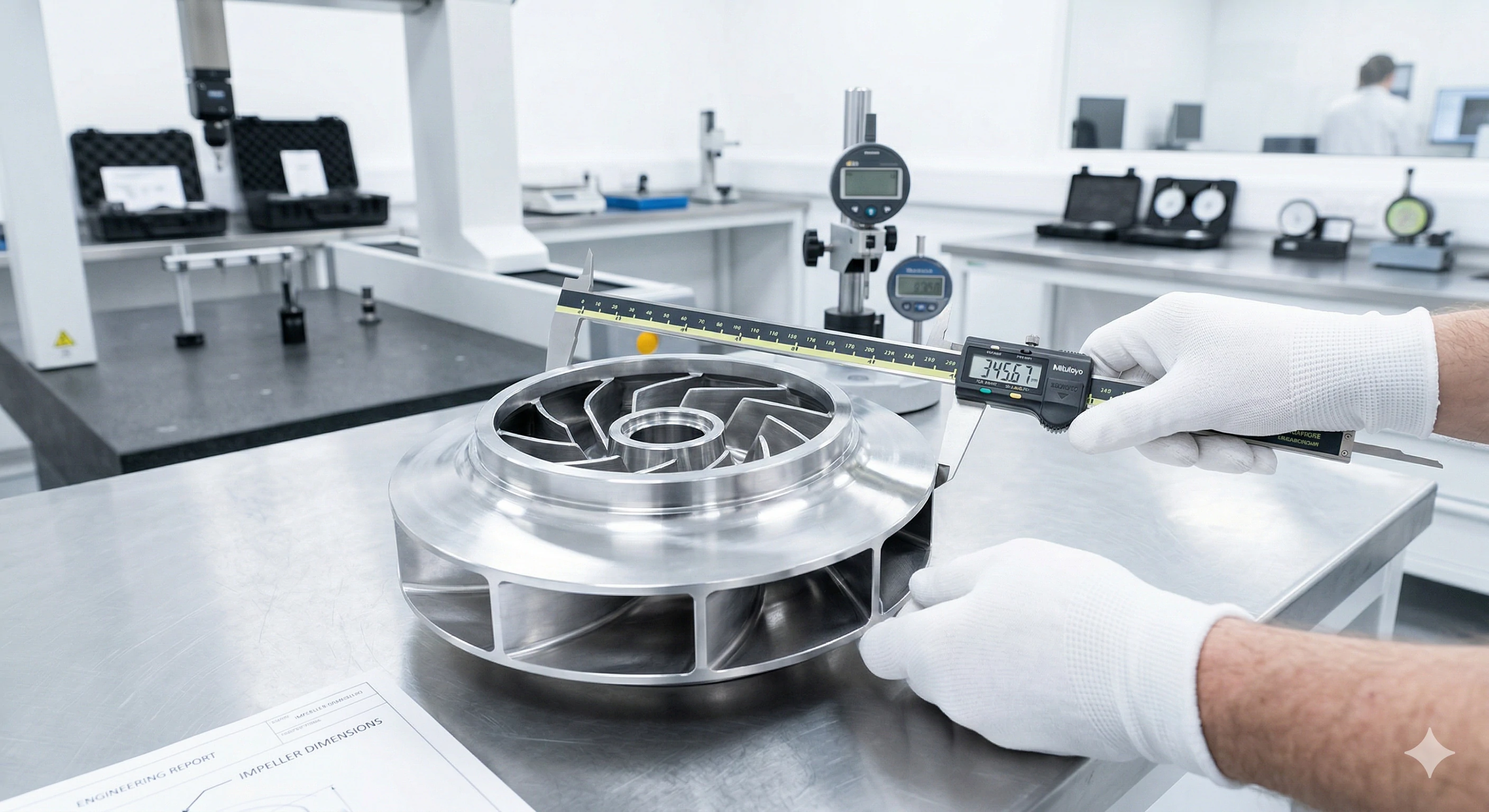
In engineering terms, an impeller is the opposite of a turbine. While a turbine extracts energy from a moving fluid and slows it down, an impeller adds energy to a fluid and speeds it up.
How Does an Impeller Work?
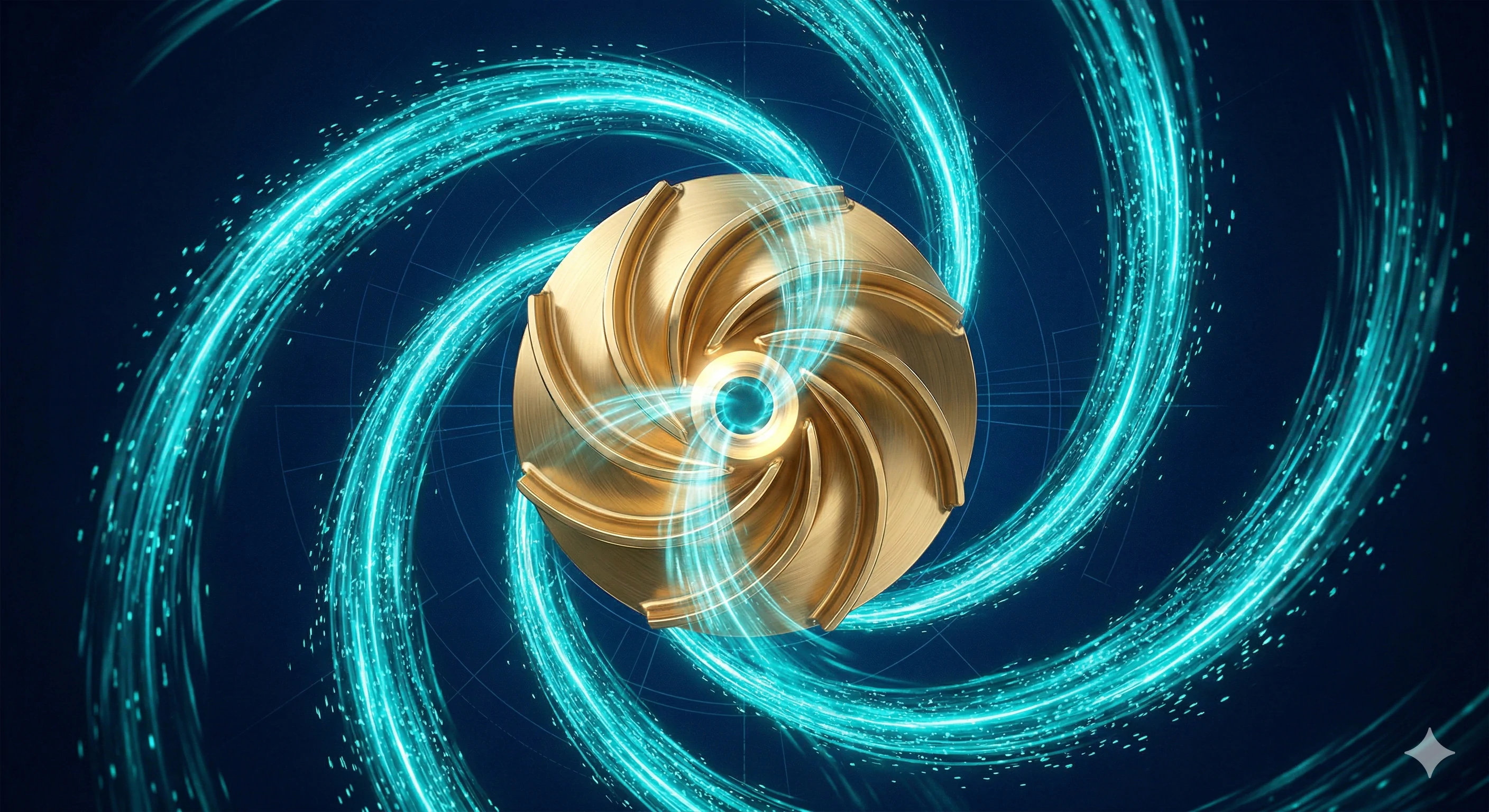
Understanding impeller operation starts with one core principle: centrifugal force. Here is a step-by-step overview of what happens when an impeller spins inside a centrifugal pump.
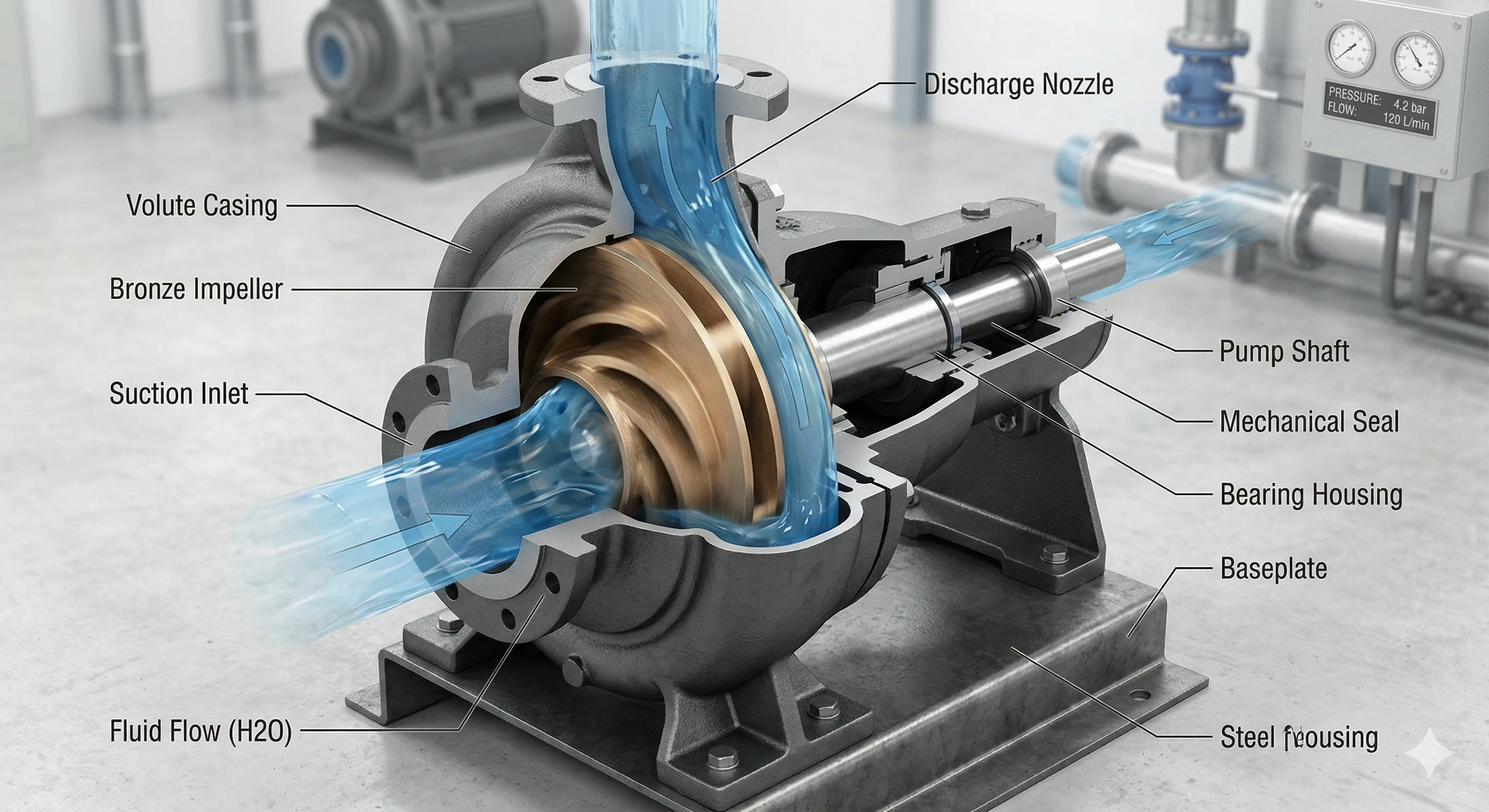
Step 1 — Fluid enters through the eye. The low-pressure zone at the center of the spinning impeller draws fluid in through the suction inlet.
Step 2 — Vanes accelerate the fluid. As the impeller rotates, its curved vanes push the fluid outward. This increases the fluid's velocity and kinetic energy.
Step 3 — The casing converts velocity to pressure. The pump's volute (a spiral-shaped casing) or diffuser captures the fast-moving fluid and gradually slows it down. According to , decreasing velocity translates into increasing pressure.
Step 4 — Fluid exits through the discharge. The pressurized fluid leaves the pump through the discharge nozzle, ready to travel through the piping system to its destination.
The efficiency of this process depends heavily on several factors: impeller geometry, the clearance between the impeller and the casing, rotational speed, and the properties of the fluid being pumped.
Key Performance Concepts
Best Efficiency Point (BEP): Every pump has an operating point at which it transfers energy most efficiently. The impeller design directly shapes where this point falls on the pump curve. Operating too far from BEP leads to wasted energy, excess vibration, and accelerated wear.
Net Positive Suction Head (NPSH): The available suction pressure at the pump inlet must exceed the minimum required by the impeller design. If it does not, cavitation occurs — vapor bubbles form and collapse against the impeller surfaces, causing pitting damage and performance loss.
Specific Speed: This dimensionless number classifies impellers by their geometry and ideal operating conditions. Low specific-speed impellers produce high head at low flow (radial flow), while high specific-speed impellers produce high flow at low head (axial flow).
Types of Impellers
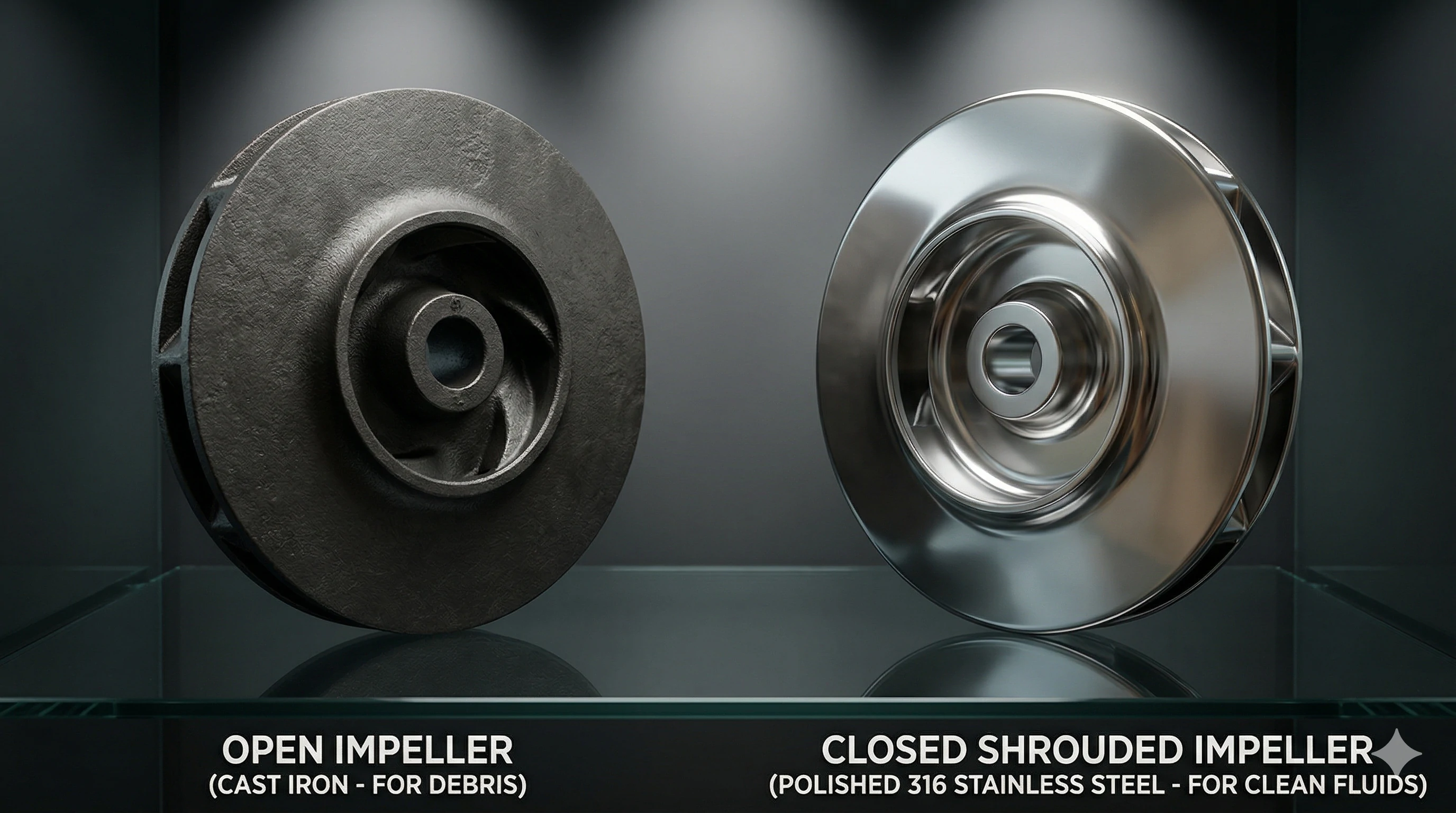
Impellers can be classified in two main ways: by their structural design (open, semi-open, closed, or vortex) and by their flow pattern (radial, axial, or mixed flow). Both classifications matter when selecting the right impeller for an application.
Classification by Structure
Open Impeller
An open impeller consists of vanes attached directly to a central hub, with no front or back shroud enclosing them. Because the vanes are fully exposed, this design allows large suspended solids, fibrous material, and slurries to pass through without clogging.
Advantages:
-
Excellent for pumping liquids with high solids content, such as
-
Easier to inspect, clean, and maintain than enclosed designs
-
Less prone to sand locking than closed impellers
-
Lower manufacturing cost
Limitations:
-
Lower hydraulic efficiency compared to closed impellers because fluid can bypass the vanes
-
Vanes are more susceptible to wear since they lack protective shrouds
-
Operates effectively across a narrower range of specific speeds
-
Clearance between the vanes and the pump casing must be carefully maintained; as the vane edges wear, efficiency drops
Open impellers are the go-to choice for small pumps handling dirty or debris-laden fluids.
Semi-Open Impeller
A semi-open impeller adds a single back plate (also called a back shroud) to the hub-and-vane assembly. This gives the component more structural strength than a fully open design while still allowing reasonable passage of solids.
Advantages:
-
Stronger than open impellers, allowing operation at higher speeds and pressures
-
A good middle-ground for applications involving moderately contaminated fluids
-
Can handle mixed solid-liquid flows more effectively than a closed design
-
Clearance adjustment on the open side can compensate for wear over time
Limitations:
-
Not as efficient as closed impellers for clean liquid service
-
Not as solids-tolerant as fully open impellers
-
Wear on the open face still requires periodic clearance adjustments
Semi-open impellers are frequently used in chemical processing, food production, and general industrial applications where fluids contain some particulate matter but not heavy slurries.
Closed Impeller (Shrouded Impeller)
A closed impeller — also called a shrouded impeller — encloses its vanes between a front shroud and a back shroud. This creates defined flow channels that prevent fluid from leaking around the vane tips, resulting in the highest hydraulic efficiency of all structural types.
Advantages:
-
Highest efficiency and pressure output among impeller types
-
Reduced thrust load on the shaft, which extends bearing life and increases reliability
-
Capable of operating over a wider range of specific speeds
-
Well-suited to and applications demanding consistent high pressure
Limitations:
-
More complex and expensive to manufacture, often requiring additional wear rings
-
Cannot handle solids effectively; particles can become trapped and cause clogging
-
More difficult to inspect and clean than open or semi-open designs
-
Efficiency decreases as wear ring clearance increases over time
Closed impellers dominate in clean-water applications, booster pump systems, HVAC circulation, and high-pressure industrial processes.
Vortex Impeller (Recessed Impeller)
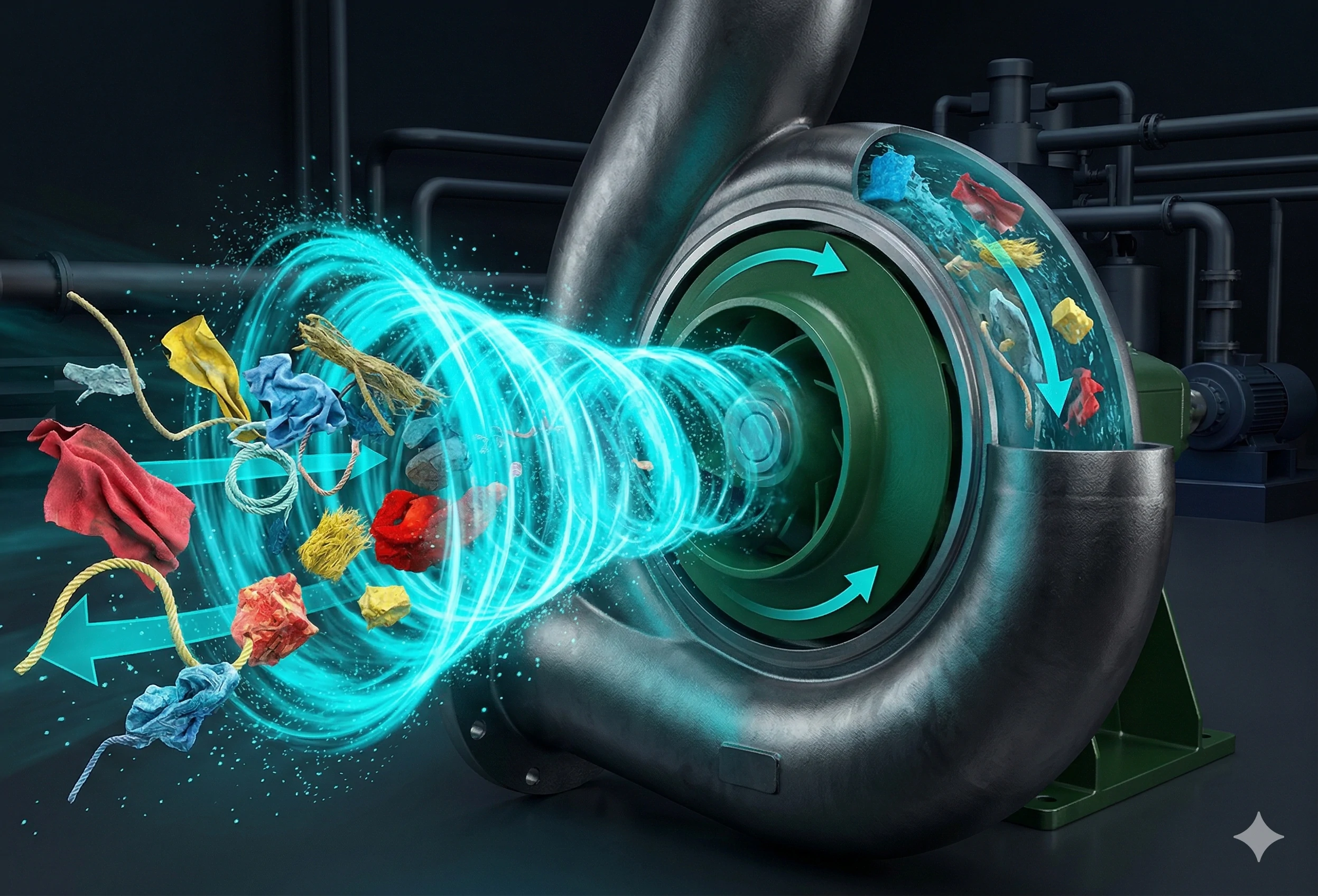
The vortex impeller takes a fundamentally different approach. Instead of making direct contact with the pumped fluid, the impeller is positioned recessed behind the volute passage. As it spins, it generates a swirling vortex that draws the fluid through the pump with minimal contact between the impeller and the pumped material.
Advantages:
-
Exceptional resistance to clogging — the wide, unobstructed flow path allows rags, fibrous material, and large solids to pass freely
-
Significantly reduced wear because the impeller does not continuously contact abrasive particles
-
Ideal for stringy, fibrous waste that would quickly wrap around conventional impeller vanes
-
Gentle pumping action preserves delicate or shear-sensitive materials
-
Low vibration due to the absence of pulsating pressure
Limitations:
-
Lower efficiency than all other impeller types, often around 50% or less
-
Requires larger motors to compensate for the efficiency loss
-
Higher energy consumption and operating costs
-
Not suitable for applications requiring high head or precise flow control
Vortex impellers are indispensable in , sewage ejection, sludge handling, and any application where preventing clogs is more important than maximizing efficiency.
Classification by Flow Pattern
Radial Flow Impellers
Radial flow impellers direct fluid perpendicular to the shaft — outward from the center to the perimeter. They produce high pressure (head) at relatively low flow rates. Most closed and semi-open pump impellers operate in this category. In mixing applications, radial flow impellers generate high shear stress, making them effective for emulsifying immiscible liquids or dispersing gases into liquids.
Axial Flow Impellers
Axial flow impellers push fluid parallel to the shaft, much like a fan or marine propeller. They produce high flow rates at relatively low head. In mixing tanks, axial flow impellers promote bulk fluid movement and circulation, making them ideal for blending, homogenization, and solids suspension.
Mixed Flow Impellers
Mixed flow impellers combine elements of both radial and axial designs, directing fluid at an angle between the two extremes. They offer a balance of moderate head and moderate flow. This category is common in medium-specific-speed applications such as irrigation pumps, flood control, and some industrial mixing operations.
Impeller Materials: Rubber, Plastic, Metal, and More
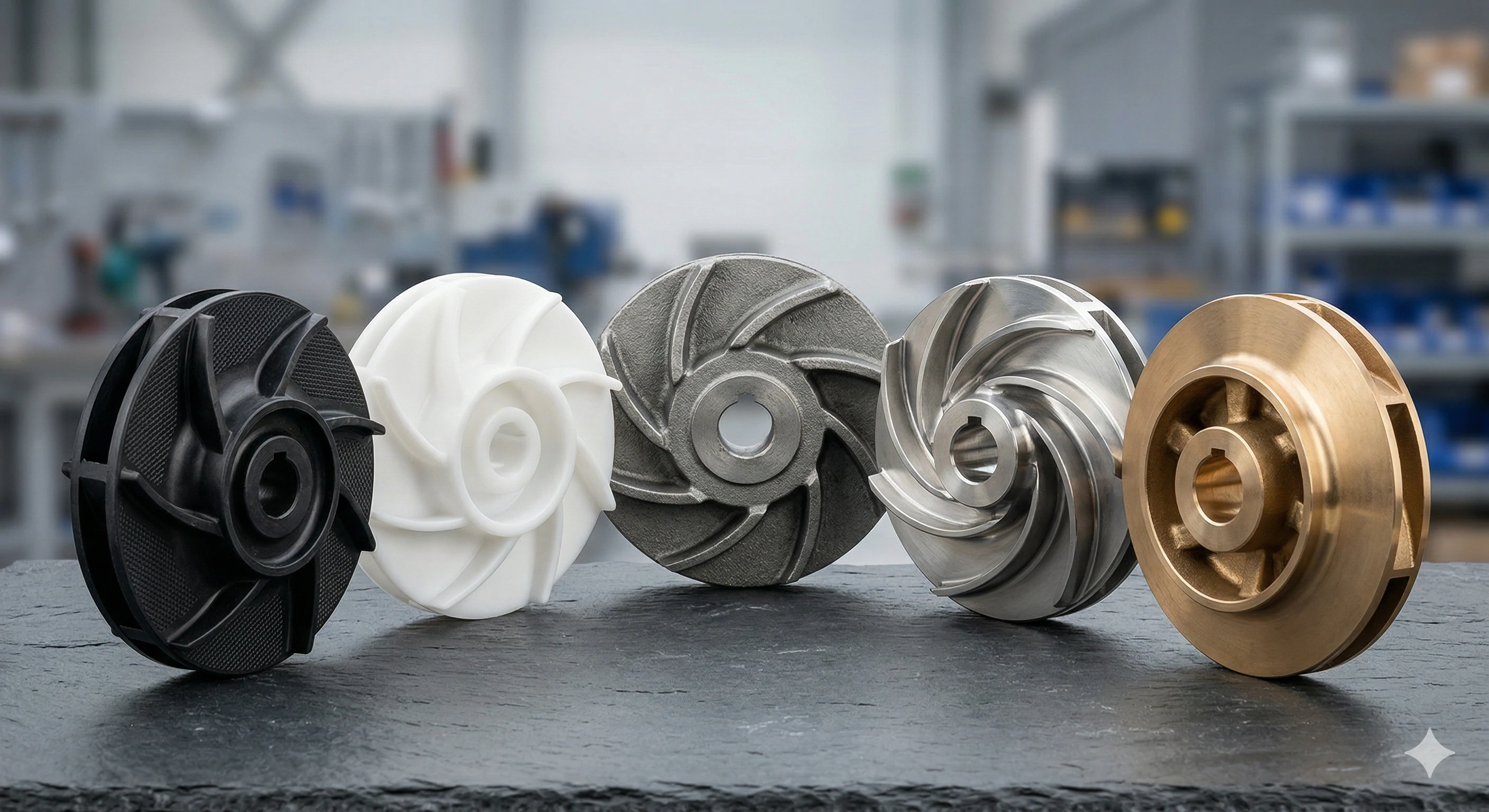
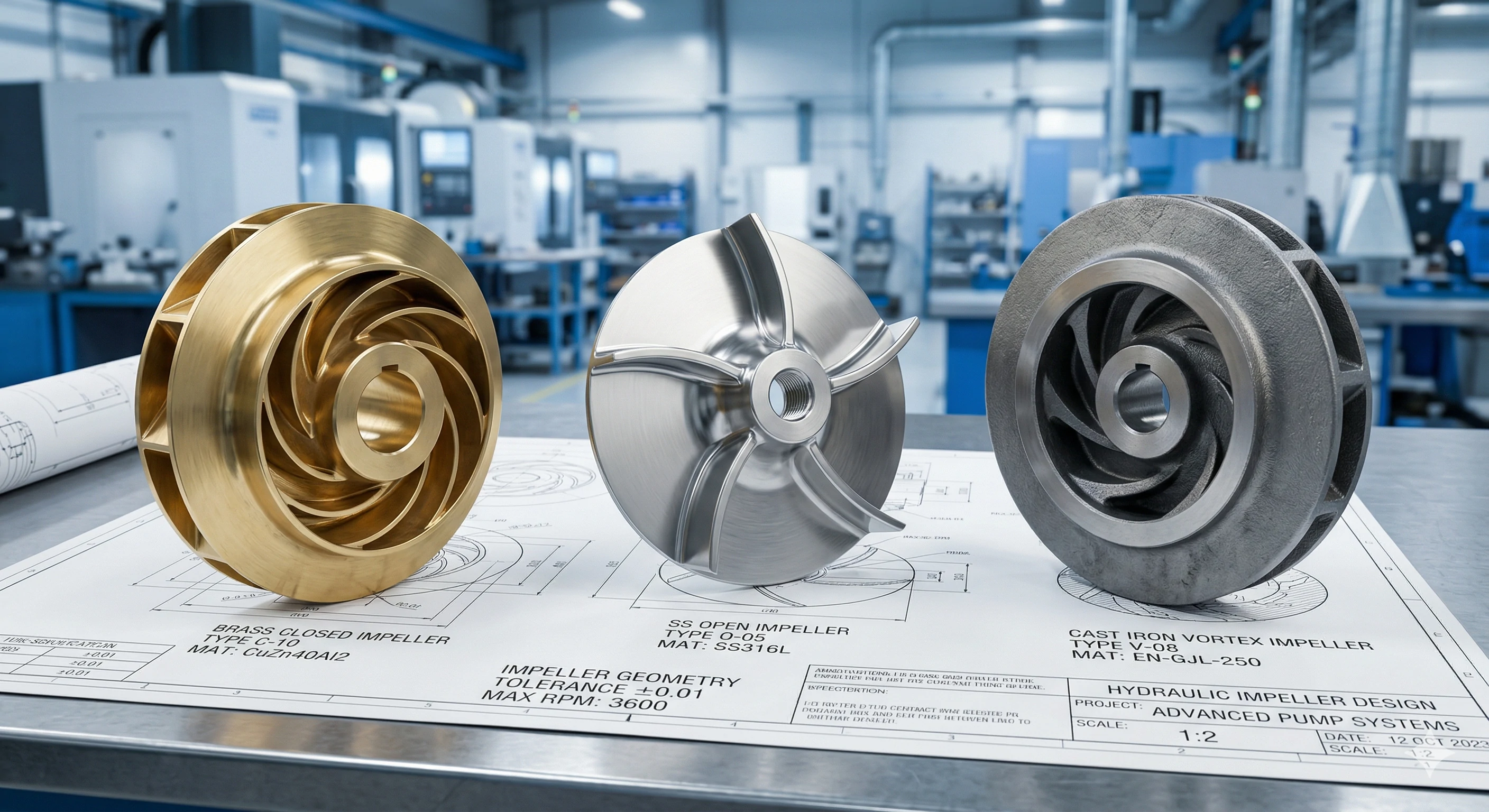
The material an impeller is made from directly affects its durability, chemical resistance, temperature tolerance, and cost. Here is a breakdown of the most common options.
Impeller Rubber
Rubber impellers — often made from neoprene, nitrile, or EPDM — are widely used in flexible impeller pumps. In this design, the rubber vanes flex as the impeller rotates inside an eccentric housing, creating suction and discharge zones without the need for valves. Rubber impellers are common in marine raw-water cooling systems, small transfer pumps, and food-grade applications. They offer excellent resistance to abrasion and can conform to tight tolerances, but they deteriorate quickly when run dry and have limited chemical and temperature resistance.
Impeller Plastic
Plastic impellers are manufactured from , PVDF (polyvinylidene fluoride), PEEK, and glass-filled nylon. They offer outstanding corrosion resistance, low weight, and economical pricing. Plastic impellers are common in chemical transfer pumps, laboratory equipment, aquarium pumps, and light-duty industrial applications. However, they cannot handle high temperatures and have lower mechanical strength than metal alternatives.
Cast Iron
Cast iron is one of the most traditional impeller materials, offering good strength, wear resistance, and affordability. It is the standard choice for general-purpose water pumps, fire pumps, and HVAC circulating systems. The downside is limited corrosion resistance, which makes cast iron impellers unsuitable for acidic or highly corrosive fluids.
Stainless Steel
Stainless steel impellers (commonly 304 or 316 grades) combine high strength with excellent corrosion resistance. They are the default choice in food and beverage processing, pharmaceutical manufacturing, chemical plants, and marine environments. 316 stainless steel, in particular, provides superior resistance to chloride-induced pitting and is often required by sanitary process standards. The main disadvantage is higher cost compared to cast iron or plastic.
Bronze and Brass
Bronze impellers are favored in marine applications because of their natural resistance to saltwater corrosion. They are also commonly used in potable water systems and fire pumps. Brass impellers offer similar benefits at a lower cost but with reduced durability.
Specialty Alloys
For extreme service conditions — high temperatures, highly corrosive chemicals, or severe abrasion — impellers may be manufactured from duplex stainless steel, Hastelloy, titanium, or ceramic-lined composites. These materials carry a significant cost premium but are essential in demanding environments such as offshore oil and gas, chemical reactors, and desalination plants.
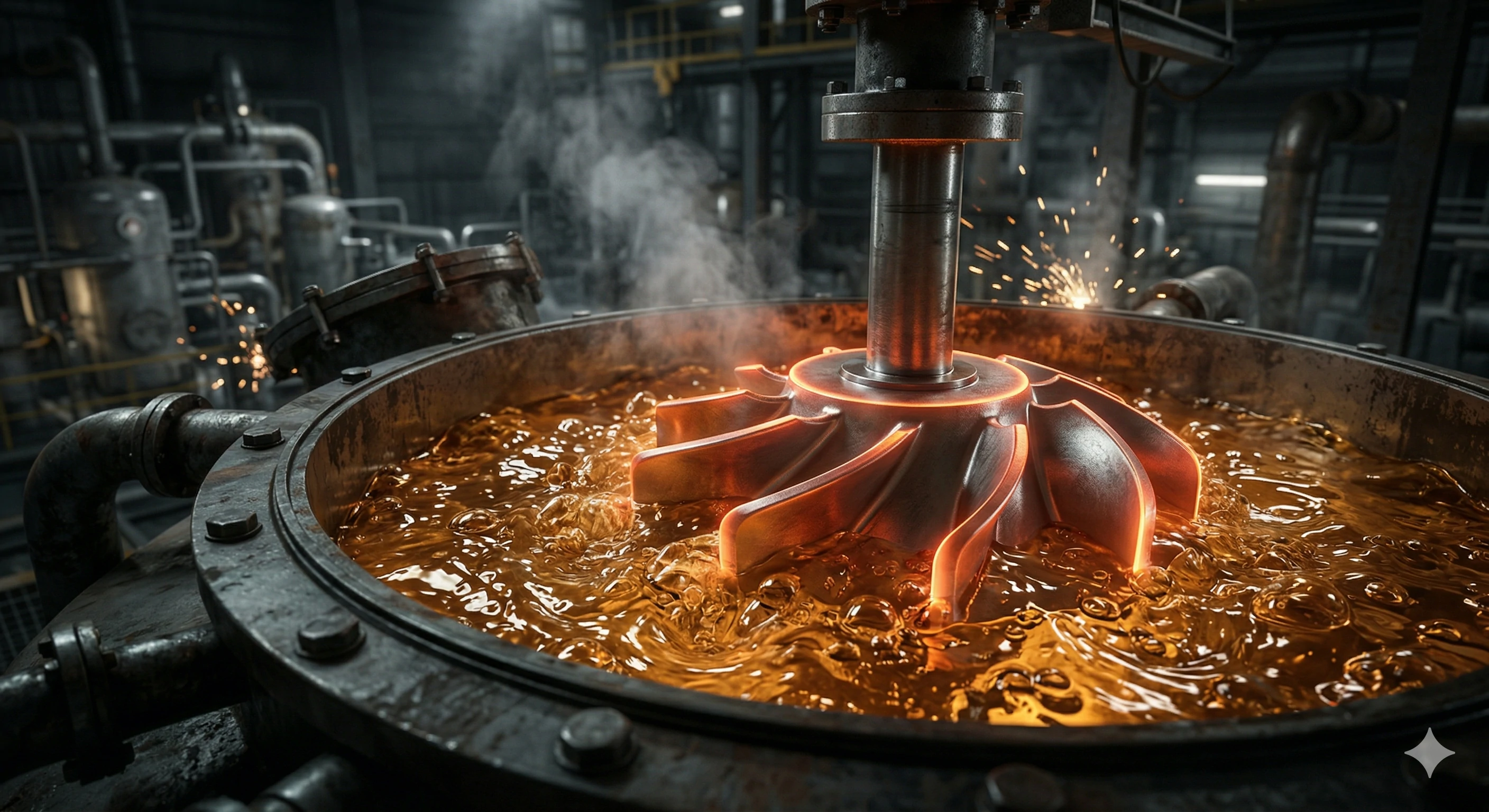
Material selection guide for centrifugal pump components
Impeller vs Propeller: What Is the Difference?
This is one of the most commonly asked questions about impellers, and for good reason — the two components look similar and both use rotating blades to move fluid. However, they serve fundamentally different purposes.
Core Difference
An impeller draws fluid into an enclosed or semi-enclosed system and increases its pressure. It operates inside a housing — a pump casing, compressor chamber, or mixing tank — and its primary job is to add energy to the fluid. The housing confines the flow and converts the kinetic energy into pressure.
A propeller, by contrast, pushes fluid in an open environment to generate thrust. It operates without a surrounding housing and moves the vehicle (or the fluid in an open tank) by accelerating the fluid in one direction. The primary job is to produce linear thrust, not pressure.
Summary of Key Differences
| Feature | Impeller | Propeller |
|---|---|---|
| Primary function | Increases fluid pressure within a closed system | Generates thrust in an open fluid environment |
| Housing | Enclosed inside a pump casing or volute | Operates in open air or water |
| Force type | Creates suction (intrinsic force) | Creates push (extrinsic force) |
| Flow direction | Radial, axial, or mixed depending on design | Primarily axial |
| Typical applications | Centrifugal pumps, compressors, jet engines, mixers | Boats, aircraft, drones, submarines |
| Blade design | Short, curved vanes optimized for pressure | Long, angled blades optimized for thrust |
Where They Overlap
In a strict engineering sense, propellers are actually a sub-class of impellers. Both use rotating blades to impart energy to a fluid, and both rely on principles derived from Bernoulli's equation and . The distinction is largely about the operating environment and the intended outcome. In a boat, for example, the propeller pushes water backward to move the vessel forward, while the impeller inside the engine's cooling pump draws raw water inward to keep the engine at operating temperature.
Agitator vs Impeller: Which Is Better?
This question arises most often in two very different contexts: industrial mixing and household washing machines. The answer depends entirely on the application.
In Industrial Mixing
In mixing and chemical processing, an agitator is the complete mechanical assembly — motor, shaft, and impeller combined. The impeller is the rotating component at the end of the shaft that actually contacts and moves the fluid. So technically, every agitator uses an impeller. The real question in industrial settings is which type of impeller to mount on the agitator: axial flow (for blending and solids suspension), radial flow (for gas dispersion and emulsification), or specialty designs like anchor or gate impellers (for high-viscosity materials).
In Washing Machines
In the laundry world, "agitator" and "impeller" refer to two distinct cleaning mechanisms found in top-loading washers.
Agitator washers use a tall central post with fins or vanes that twists back and forth during the wash cycle. The post physically rubs against clothing, creating friction that breaks apart dirt and stains. This approach is effective for heavily soiled items and delivers shorter wash times. However, the aggressive action can be rougher on delicate fabrics, and the central post takes up space inside the drum, limiting load capacity.
Impeller washers use a low-profile cone, disc, or fin at the bottom of the wash basket that spins to create water currents. Instead of rubbing against the clothes directly, the impeller drives garments from the outer rim of the basket toward the center and back, causing them to rub against each other. This produces a gentler clean, leaves more room in the drum for larger loads, and typically uses less water and energy.
So Which Is Better?
Neither is universally superior. Agitator washers tend to be more effective at removing tough, ground-in stains through their more vigorous mechanical action. Impeller washers are gentler on fabrics, offer larger effective capacity, and are generally more water- and energy-efficient. Many modern brands now offer hybrid models with removable agitators, allowing you to switch between both modes depending on the load.
Common Impeller Applications by Industry
Impellers are not limited to a single field. Their versatility makes them essential across a wide range of industries.
Water and Wastewater Treatment: Closed impellers drive booster pumps and distribution systems. Vortex and open impellers handle raw sewage, sludge, and grit-laden influent where clogging resistance is critical.
Oil and Gas: High-alloy closed impellers power used in pipeline transport, refinery processes, and offshore platforms. Corrosion-resistant materials like duplex stainless steel and Hastelloy are standard.
Mining: Open impellers and heavy-duty slurry pump impellers move abrasive ore-water mixtures through processing circuits. Wear-resistant materials such as high-chrome white iron are common in these demanding applications.
Chemical Processing: Corrosion-resistant impellers — often made from PVDF, 316 stainless steel, or Hastelloy — transfer acids, solvents, and caustic solutions safely through the process.
Food and Beverage: Sanitary-grade stainless steel impellers meet food-contact regulations while handling everything from milk and juice to viscous sauces and slurries.
Marine: Rubber flexible impellers provide raw-water cooling for boat engines. Bronze impellers serve in bilge pumps, ballast systems, and fire suppression.
HVAC: Closed impellers in inline and split-case circulating pumps move hot and chilled water through building heating and cooling systems.
Medical Devices: Miniature axial-flow impellers are the core of ventricular assist devices (VADs) that support or replace cardiac function in patients with heart failure. These tiny impellers must operate continuously with extreme precision and biocompatibility.
industrial pump selection guide
Leading Impeller Manufacturers
The global impeller market is served by companies that range from large multinational pump OEMs to specialized casting foundries. Some of the most well-known names include:
-
Grundfos — A world leader in pump technology, producing a wide range of impellers for water supply, wastewater, and industrial applications
-
Xylem (Flygt) — Known for submersible wastewater impellers, including vortex and non-clog designs
-
Sulzer — Specializes in high-performance impellers for oil and gas, power generation, and chemical processing
-
KSB — A major European pump manufacturer offering impellers in cast iron, bronze, and stainless steel for industrial and building services
-
Flowserve — Produces impellers for critical-service applications in refineries, power plants, and chemical facilities
-
Jabsco (Xylem) — A leading supplier of flexible rubber impellers for marine and industrial use
-
Pentair — Provides recessed vortex impellers for wastewater and sewage applications
When sourcing impellers, consider whether you need OEM replacement parts matched to a specific pump model, or aftermarket impellers that offer cost savings or alternative materials. Always verify that dimensional tolerances, material certifications, and hydraulic performance match your system requirements.
Hydraulic Institute — pump industry standards and resources
How to Choose the Right Impeller
Selecting the right impeller is not just about picking a type — it is about matching the impeller to the full set of operating conditions. Here are the key factors to evaluate.
Fluid Properties: Is the fluid clean water, a viscous chemical, or a solids-laden slurry? Clean fluids pair well with closed impellers. Moderate solids call for semi-open designs. Heavy slurries or fibrous waste require open or vortex impellers.
Required Head and Flow Rate: Closed impellers deliver the highest head and efficiency. If your system demands high pressure, a shrouded design is usually the right call. For high-flow, low-head applications, axial flow impellers may be more appropriate.
NPSH Available: If your system has limited suction head, you need an impeller with a low NPSHr (Net Positive Suction Head required). Some impeller designs feature enlarged eyes or inducer vanes specifically to reduce NPSHr and prevent cavitation.
Chemical Compatibility: Match the impeller material to the fluid chemistry. Acidic solutions may demand PVDF or Hastelloy. Saltwater calls for bronze or 316 stainless steel. General clean-water service is well served by cast iron.
Temperature: High-temperature applications rule out most plastics and rubber. Stainless steel, specialty alloys, or ceramic-lined impellers are necessary when fluid temperatures exceed 80–100 °C.
Maintenance Access: Consider how easy the impeller will be to inspect, clean, and replace. Open impellers are the simplest to maintain. Closed impellers inside multistage pumps can require significant disassembly.
Energy Efficiency: Because impellers can account for a large share of a pump's energy consumption, choosing the most efficient design for your operating conditions directly impacts long-term operating costs. Operating at or near the pump's BEP is the single most effective way to minimize energy waste.
Impeller Maintenance and Troubleshooting
Even the best impeller will degrade over time. Regular maintenance extends service life and keeps your pump operating near its design efficiency.
Routine Inspections: Check impeller clearances at scheduled intervals. For open and semi-open impellers, adjust the gap between the vane edges and the pump casing or wear plate as wear progresses. For closed impellers, monitor wear ring clearance — as the gap increases, internal recirculation rises and efficiency drops.
Cavitation Damage: Look for pitting, erosion, or a honeycomb-like texture on the impeller surfaces near the eye. Cavitation damage indicates that the NPSHa is too close to (or below) the NPSHr. Address the root cause — often a partially closed suction valve, excessive suction lift, or high fluid temperature — rather than simply replacing the impeller.
Corrosion and Erosion: Chemical attack and abrasive wear are the most common causes of impeller degradation. If corrosion is the primary issue, upgrade to a more chemically resistant material. If erosion dominates, consider harder materials (such as high-chrome white iron for slurry service) or apply protective coatings.
Imbalance and Vibration: A damaged, eroded, or clogged impeller creates imbalance that transmits vibration through the shaft, bearings, and mounting. Excessive vibration shortens bearing life and can damage seals. If vibration analysis points to the impeller, remove it for inspection and balancing or replacement.
Replacement Timing: Do not wait for catastrophic failure. Replace impellers when clearances exceed manufacturer tolerances, when efficiency has dropped noticeably, or when cavitation or erosion damage is visible on more than a small fraction of the vane surface.
FAQ
What is the function of an impeller?
The primary function of an impeller is to transfer rotational energy from a motor to a fluid. By spinning inside a pump casing, the impeller accelerates the fluid outward through centrifugal force, increasing its velocity and pressure. This allows the pump to move the fluid from one location to another at the required flow rate and pressure.
What is the difference between an impeller and a propeller?
An impeller operates inside an enclosed housing (such as a pump casing) to draw fluid in and increase its pressure. A propeller operates in the open (such as on a boat or aircraft) to push fluid and generate forward thrust. Impellers create suction; propellers create push. Though they share similar rotating-blade mechanics, their operating environments and primary functions are distinct.
Which is better, an agitator or an impeller?
In the context of washing machines, neither is universally better. Agitator washers use a central post that physically rubs against clothes, providing aggressive stain removal but potentially being harder on fabrics. Impeller washers use a low-profile disc that creates water currents to move clothes gently against each other, offering larger capacity and lower water usage. Your best choice depends on whether you prioritize heavy-duty stain removal (agitator) or gentle cleaning with greater capacity (impeller).
What is a shrouded impeller?
A shrouded impeller is another name for a closed impeller. It features both a front and back wall (shroud) enclosing the vanes, which creates defined flow channels. This design maximizes hydraulic efficiency and pressure output but is not suitable for fluids containing solids, as the enclosed channels can clog.
What is a vortex impeller used for?
A vortex impeller is designed for applications where preventing clogs is the top priority. It sits recessed behind the volute, generating a tornado-like vortex that pulls fluid through the pump with minimal direct contact. This makes vortex impellers ideal for sewage, wastewater, sludge, and any fluid containing rags, fibrous material, or large solids.
How long does an impeller last?
Impeller lifespan varies widely depending on the material, the fluid being pumped, operating conditions, and maintenance practices. A stainless steel impeller pumping clean water in an HVAC system may last 10–15 years or more. A rubber flexible impeller in a marine cooling pump may need replacement every 2–4 seasons. A slurry pump impeller handling abrasive ore may last only weeks or months. Regular inspection and adherence to manufacturer clearance tolerances are the best way to maximize service life.
Can you repair a damaged impeller?
Minor damage can sometimes be repaired through welding, grinding, or applying protective coatings, depending on the material. However, repairs must preserve the impeller's balance and dimensional accuracy. In most cases, especially for critical or high-speed applications, replacing the impeller is more reliable and cost-effective than attempting repairs.
Conclusion
The impeller is deceptively simple in concept — a set of spinning vanes — but remarkably nuanced in practice. Choosing the right type, material, and size can mean the difference between a pump system that runs efficiently for years and one that clogs, cavitates, or burns through energy and replacement parts.
Whether you are specifying a closed impeller for a high-pressure booster pump, selecting a vortex design to handle municipal sewage without clogging, or simply deciding between an agitator and an impeller washer for your laundry room, the principles are the same: match the impeller to the fluid, the operating conditions, and the performance requirements.
If you are still unsure which impeller is right for your application, consult with a pump specialist or the manufacturer of your equipment. A small investment of time in proper selection pays enormous dividends in reliability, efficiency, and total cost of ownership.
Footnotes
1. Overview of how water supply networks distribute treated water to consumers.
2. Information on mechanical pumps used to support heart function and blood flow.
3. Learn about the physics of fluid mechanics and energy transfer in liquids.
4. Explanation of the fluid dynamics principle relating fluid speed to pressure.
5. Details on the behavior and handling of dense fluid-solid mixtures.
6. Understand the scientific definition and implications of fluid resistance to flow.
7. Processes involved in removing contaminants from municipal and industrial wastewater.
8. Details on the properties and applications of versatile thermoplastic polymers.
9. Principles of aerodynamics and hydrodynamic shapes used to generate lift and thrust.